Wednesday, February 15, 2006

Comparing Low-Carb to Low-Fat: Analyzing a review

The key to a quality meta-analysis rests in the quality of the studies included in the review. While the media continues to headline the recently published review of studies - Effects of Low-Carbohydrate vs Low-Fat Diets on Weight Loss and Cardiovascular Risk Factors - few are questioning the methods, analysis or conclusions.

As I pointed out yesterday, the researchers failed to include an important analysis in the paper - the change in cholesterol ratio (total cholesterol/HDL cholesterol) in their review. This is an important piece of information that is missing and must be part of the equation used to determine the efficacy of low-carb diets in the short and long-term.

More importantly though is the fact that the review failed to include only studies that actually met their inclusion criteria, stated in the full-text as "To be included in this meta-analysis, trials were required to use a randomized controlled design comparing the effects of a low-carbohydrate diet (defined as a diet allowing a maximum intake of 60 g of carbohydrates per day) without energy intake restriction vs a low-fat diet (defined as a diet allowing a maximum of 30% of the daily energy intake from fat) with energy intake restriction in individuals with a body mass index (calculated as weight in kilograms divided by the square of height in meters) of at least 25. Included trials had to report changes in body weight by using an intention-to-treat analysis, to have a follow-up of at least 6 months, and to include individuals 16 years and older. We excluded trials with crossover or sequential designs."

In reviewing the studies that made the final cut, it's apparent that not all met the inclusion criteria because some failed to implement the treatment as defined in the study in one or both groups.

Case in point - Dansinger ML, Gleason JA, Griffith JL, Selker HP, Schaefer EJ. Comparison of the Atkins, Ornish, Weight Watchers, and Zone diets for weight loss and heart disease risk reduction: a randomized trial. JAMA. 2005;293:43-53. FULL TEXT - set out to compare four different dietary approaches with specific macronutrient restrictions:
  • Atkins = 20g or less carbs per day, gradual increase to 50g per day
  • Ornish = 10% fat per day vegetarian
  • Weight Watchers = 24-32 "points" (1200-1600 calories) per day
  • Zone = 30% fat, 40% carbohydrate, 30% protein

So far, so good - this trial did indeed look to compare low-carb and low-fat. But, did the groups actually follow the diets?

That is an important consideration when including a trial in a meta-analysis of comparable trials. And in this instance, this trial failed to maintain the inclusion criteria for the meta-analysis since participants across all groups in the study failed to eat according to their diet group requirements - they failed in "dietary adherance" of the trial - at all timed follow-ups in the study:

  • Atkins
    1-Month = 68g carb (+18g to +48g of restriction goal)
    6-Month = 190g carb (+140g of restriction goal)
    12-Month = 190g (+140g of restriction goal)
  • Weight Watchers
    1-Month = 1477 calories (within range)
    6-Month = 1755 calories (+155 calories of restriction goal)
    12-Month = 1832 calories (+232 calories of restriction goal)
  • Zone
    1-Month = 45:32:23
    6-Month = 45:31:24
    12-Month = 40:36:24
  • Ornish
    1-Month = 17% calories from fat (+7% of restriction goal)
    6-Month = 29% calories from fat (+19% of restriction goal)
    12-Month = 32% calories from fat (+22% of restriction goal)

Now while this study wanted to follow four different groups eating four different diets, the participants were not in compliance with their respective dietary restrictions. This study simply cannot provide us with usable data about how a low-carb diet (60g or less carbs per day) effects cholesterol when compared with a low-fat diet (30% or less calories from fat per day).

Of the six studies that "made the cut" for inclusion, we find that researchers were able to achieve participant compliance in only one study used for the meta-analysis. One other did not report the diet composition at baseline or during follow-up, so we have no way of knowing if those participants actually ate the assigned low-carb diet or low-fat diet.

When attempting a meta-analysis it's important to not only find studies that meet your intial inclusion criteria, but to also assure that you're comparing apples-to-apples data. This meta-analysis is not doing that and is therefore just another that attempts to do what is currently impossible - tell us if a low-carb diet (a truly low-carb diet) is better, the same or worse than a low-fat diet.

Did I just say "impossible"...?

Yes, I did.

Unfortunately we have no really good long-term studies comparing low-carb diets to anything else - low-fat, Mediterranean, standard American - nada, zip, zilch.

We need them. We need studies that don't just set out to have subjects eat a low-carb diet and then don't - we need those participating to actually stick to it so we can really see how a low-carb diet performs not only for weight loss, but also for reduction of risks and benefits to health.

I have to tell you though, until we move past the fat-phobia that is embedded in the collective thinking, this is going to be a difficult task - studies are compromised too often by those guiding the participants when they include advice on what to eat from dietitians who are committed to the concept that dietary fat and saturated fat is harmful, who are dedicated to the idea that restricting most fruits for a period is detrimental to health or hold that one must have grains in their diet for health.

It really isn't all that hard to pick out those studies that sought to investigate the effects of a low-carb diet, yet stifled participants attempts with fat-phobic recommendations in the process. The quick way to tell if those following low-carb were given poor advice about dietary fats for a low-carb diet...ask - what amount of total fat and saturated fat did particpants eat?

If they were instucted to follow Atkins (or an Atkins-type low-carb diet) at minimum they'll eat 60% of calories from total fat and about 15-18% of calories from saturated fat each day on 1600-calories. Cholesterol intake goes way up if one is following a low-carb diet according to the "rules" established by Dr. Atkins in his books.

Yet when we look at another study included, Brehm BJ, Seeley RJ, Daniels SR, D’Alessio DA. A randomized trial comparing a very low carbohydrate diet and a calorie-restricted low fat diet on body weight and cardiovascular risk factors in healthy women. J Clin Endocrinol Metab. 2003;88:1617-1623. FULL TEXT - we find that part of the intervention included "Two registered dietitians delivered a 3-month intervention aimed at promoting dietary compliance. Group meetings with subjects on the same diet were held biweekly on the University of Cincinnati campus and addressed cooking tips, stress management, behavior modification, and relapse prevention. On alternating weeks, subjects met for individual counseling sessions during which their assigned dietitian reviewed their 3-d food records from the previous week, analyzed by Nutritionist V (First Data Bank, San Bruno, CA), and provided dietary recommendations and positive reinforcement. Subjects were advised to continue their baseline level of activity."

With this potential to corrupt the dietary recommendations to the low-carb group - to basically cause them to eat a diet with less fat - let's see how those participating in the low-carb arm ate at the follow-ups:

  • 3-Month
    1156 Calories
    57% fat (71g fat)
    15% carb (41g carb)
    28% protein (78g protein)
    Cholesterol - 461mg
  • 6-Month
    1302 Calories
    46% fat (65.5g fat)
    30% carb (97g carb)
    23% protein (74g protein)
    Cholesterol - 285mg

After years of designing menus to comply with the Atkins diet, the above ratios and gram-intakes are IMPOSSIBLE if one is just following the recommendations in Dr. Atkins' New Diet Revolution. I can speculate what happened though - at the 3-month follow-up when the dietitians saw 461mg of cholesterol in the diet of those following low-carb, they panicked and started down the road of altering the diet to reduce the intake of cholesterol.

Want to know what happened?

From baseline to the 3-month mark, those following the low-carb diet saw their total cholesterol drop from 206 to 185, their LDL drop from 124 to 113, their HDL increase from 51 to 54 and their blood pressure drop from 116/79 to 112/72. All undeniably improvements in risk markers.

After changing their macronutrient intakes - specifically reducing their fat, saturated fat and cholesterol while increasing carbohydrate intake...those following the low-carb diet watched their total cholesterol rise from 185 to 205 (back to where they started), their LDL increase to 124 (where they started) and their HDL continue to rise to 58 (thankfully since this offset their other changes in cholesterol. In addition their blood pressure went up too - to 114/74.

We find such problems in a number of studies trying to investigate low-carb diets - those who are part of the intervention are interferring with what participants are eating because they're entrenched in the belief that dietary fats and cholesterol are harmful and therefore unacceptable in the diet at any level above what is recommended.

Part of the process of discovery is to leave your assumptions behind and let those in a trial follow the study design without trying to adjust things that we "think" might be bad. Let the data come as it will - don't interfere. As we can clearly see in the above, those who were allowed to eat high levels of fat and cholesterol were having some great improvements - when they altered that and changed how they were eating, they lost those improvements rapidly.

Low-carb diets hold so much promise - yet we can't seem to grasp that study participants should just be allowed to follow the low-carb recommendations, which include eating higher amounts of cholesterol and dietary fat. Until we finally accept the idea of doing a study and allowing participants to eat freely from the foods allowed, we're not going to answer the critical questions to determine the safety or efficacy of low-carb diets!

Tuesday, February 14, 2006

Low-Carb Diets Improve Cholesterol Ratios More than Low-Fat Diets

As usual, the media jumps to decalre that low-carb diets aren't good for you:

The articles all try to disseminate the review published yesterday in the Archives of Internal Medicine, Effects of Low-Carbohydrate vs Low-Fat Diets on Weight Loss and Cardiovascular Risk Factors (Arch Intern Med. 2006;166:285-293), led by researchers from the University Hospital Basel, Switzerland.

The conclusions, from the abstract - Conclusions Low-carbohydrate, non–energy-restricted diets appear to be at least as effective as low-fat, energy-restricted diets in inducing weight loss for up to 1 year. However, potential favorable changes in triglyceride and high-density lipoprotein cholesterol values should be weighed against potential unfavorable changes in low-density lipoprotein cholesterol values when low-carbohydrate diets to induce weight loss are considered.

Later, in the discussion section of the full-text, we find the following ominous warning: In our opinion, the unfavorable changes in LDL-C levels caution against the conclusion that low-carbohydrate diets can be generally recommended to promote weight loss. No trials of low-carbohydrate diets have been performed that are powered for clinical end points (eg, myocardial infarction or death). It is therefore uncertain whether the beneficial effects of these diets on HDL-C and triglyceride levels outweigh the unfavorable changes in LDL-C level. In contrast, trials of reduced-fat diets, in conjunction with other lifestyle modifications such as increased physical activity, have demonstrated long-term maintenance of weight reduction and delayed onset of diabetes. Furthermore, randomized controlled trials have also demonstrated the benefits of the Mediterranean diet on secondary prevention of cardiovascular disease.

As I started to read through the paper, one thing was clear, the analysis was short-sighted and failed to include important additional information - namely the improvement or decline in cholesterol ratios, a standard used by clinicians to determine one's risk of heart disease. There are two such ratio calculations that may be used - the TC/HDL ratio (total cholesterol to HDL) or the LDL/HDL ratio.

I'm not sure why the researchers failed to include this data, but it is quite revealing and should have been included. You'll see why in a moment...first let's look at the studies included:

  • Brehm BJ, Seeley RJ, Daniels SR, D’Alessio DA. A randomized trial comparing a very low carbohydrate diet and a calorie-restricted low fat diet on body weight and cardiovascular risk factors in healthy women. J Clin Endocrinol Metab. 2003;88:1617-1623.FULL TEXT
  • Foster GD, Wyatt HR, Hill JO, et al. A randomized trial of a low-carbohydrate diet for obesity. N Engl J Med. 2003;348:2082-2090.FULL TEXT
  • Samaha FF, Iqbal N, Seshadri P, et al. A low-carbohydrate as compared with a low-fat diet in severe obesity. N Engl J Med. 2003;348:2074-2081.FULL TEXT
  • Stern L, Iqbal N, Seshadri P, et al. The effects of low-carbohydrate versus conventional weight loss diets in severely obese adults: one-year follow-up of a randomized trial. Ann Intern Med. 2004;140:778-785. FULL TEXT
  • Yancy WS Jr, Olsen MK, Guyton JR, Bakst RP, Westman EC. A low-carbohydrate, ketogenic diet versus a low-fat diet to treat obesity and hyperlipidemia: a randomized, controlled trial. Ann Intern Med. 2004;140:769-777.FULL TEXT
  • Dansinger ML, Gleason JA, Griffith JL, Selker HP, Schaefer EJ. Comparison of the Atkins, Ornish, Weight Watchers, and Zone diets for weight loss and heart disease risk reduction: a randomized trial. JAMA. 2005;293:43-53.FULL TEXT

To compare the data, they followed a very simple approach - actual numbers from baseline to six months or baseline to one-year and measured individually the changes in Total Cholesterol (TC), LDL, HDL and Triglycerides (TG). And quite frankly, when we review this simplistic analysis, things do indeed look bleak for the low-carb diet's impact on cholesterol levels.

But what's missing?

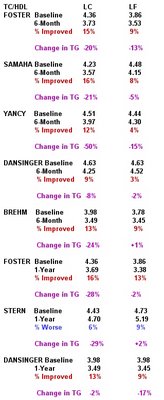
Ahhh...the baseline ratios compared with the follow-up ratios or TC to HDL! This is an important ratio to pay attention to - when a diet causes the ratio to decrease, that's good - if it causes the ratio to increase, that's bad. When comparing two dietary approaches, looking at the impact each has on the baseline ratio to the follow-up ratio is, in my opinion, a much better determinant of how the diet is increasing or decreasing risk of something like cardiovascular disease. And, I'm not alone with this thinking - in fact, studies support that "In addition to LDL cholesterol, the total to HDL cholesterol (TC/HDL) ratio is one of the most potent lipid predictors for cardiovascular disease."

What do these ratios look like? How about we take a look now...

What does the data now tell us?

On average, at six-months, those following a low-carb diet improved (lowered) their TC/HDL ratio by 13% compared to the low-fat diet improvement of 6.6%. Add to this, those on low-carb averaged a 24.6% decrease in their triglycerides compared with the 6.8% decrease by those following low-fat - a more than three-fold improvement in the low-carb group.

On average, at one-year, those following a low-carb diet improved (lowered) their TC/HDL ratio by 7.6% compared to the low-fat diet improvement of 6.8%. Add to this, those on low-carb averaged a 19.6% decrease in triglycerides compared with a 7% decrease by those following low-fat - more than a two-fold improvement in the low-carb group.

What none of this data can tell you though is if the subjects actually ate a low-carb diet!

Unfortunately Foster et al doesn't include macronutrient consumption in their paper, but all the other authors did. While the inclusion criteria in the present review stated that the data reviewed would meet this criteria: To be included in this meta-analysis, trials were required to use a randomized controlled design comparing the effects of a low-carbohydrate diet (defined as a diet allowing a maximum intake of 60 g of carbohydrates per day) without energy intake restriction vs a low-fat diet (defined as a diet allowing a maximum of 30% of the daily energy intake from fat) with energy intake restriction in individuals with a body mass index (calculated as weight in kilograms divided by the square of height in meters) of at least 25.

We find instead that the stubjects in the studies were actually eating more carbohydrate:

At the six month follow-up, subjects following "low-carb" were consuming:

  • Samaha 150.7g carb 37.8% of calories
  • Yancy 29.5g carb 8.0% of calories
  • Dansinger 190.0g carb 41.1% of calories
  • Brehm 98.6g carb 39.7% of calories

At the one-year follow-up, subjects following "low-carb" were consuming:

  • Stern 120.0g carb 32.8% of calories
  • Dansinger 190.0g carb 40.2% of calories

Once we begin to really look at this data, we now understand that with the exception of one (maybe two if subjects in Foster et al consumed less than 60g of carbohydrate each day) that this review isn't really a meta-analysis of low-carb diets versus low-fat diets, but controlled-carb diets versus low-fat diets.

This is an important distinction since the evidence thus far tells us that strictly controlling carbohydrate - to truly "low-carb" levels of 60g or less of carbohydrate a day - does have an even greater capacity to improve TC/HDL ratios and triglycerides.Generally, it is understood within the scientific community that low-carb diets must be no more than 60g of carbohydrate a day to be deemed "low-carb" and that higher intakes of carbohydrate that remain at or below 40% of energy from carbohydrate are not "low-carb" but "controlled-carb" or "carbohydrate restricted."

The researchers of this particular paper failed to note the carbohydrate level consumed or its potential relation to cholesterol outcomes.

They also failed to really do the important work of examining whether these controlled-carb diets improved overall TC/HDL ratios. As we see above, they did and much more so than the low-fat diets.

When we take the overall improvements in TC/HDL ratios and also look at improvements in triglycerides, who can say with a straight face that controlled-carb isn't a better better approach?

Monday, February 13, 2006

Low-Fat Diets - Dogma or Data?

Main Entry: dog·ma
Function: noun
Etymology: Latin dogmat-, dogma, from Greek, from dokein to seem
1 a : something held as an established opinion; especially : a definite authoritative tenet
b : a code of such tenets
c : a point of view or tenet put forth as authoritative without adequate grounds

Main Entry: scientific method
Function: noun
1. the principles and empirical processes of discovery and demonstration that are characteristic of or necessary for scientific investigation.

The scientific method involves an observation, the formulation of a hypothesis about the observation, experimentation designed to demonstrate the truth or falseness of the hypothesis, and a conclusion that validates or modifies the hypothesis.

As I've pointed out a number of times, dogma isn't science.

Science is an objective, disciplined methodology for investigating the world around us. Scientists — those having expert knowledge of one or more of the existing scientific disciplines - use the scientific method in their efforts to extend and deepen our understanding of the world. Good scientists are open the prospect of being humbled by their findings. You see, scientific inquiry isn't about being "right," it's about finding truth through a mindset of doubting, questioning, and openness to the self-correcting spirit of scientific inquiry.

The necessary commitments of a scientist in search of the truth include:
  • A search for collectively justified knowledge (as opposed to opinions and unjustified beliefs)
  • A justification based on perceptual grounds not shaped by individual or cultural factors
  • A willingness to change if required by evidence and reasoning (open-mindedness)
  • An unwillingness to change unless required by evidence and reasoning (skepticism)
  • An awareness of the fallibility of human knowledge, and the resultant doubting and questioning

Interestingly, the words "science" and "scissors" are both related to the Greek word "schizo" meaning "to split."

Think of science as scissors: two blades of inquiry are better than one for cutting into the unknown.

Today explanations of WHI findings are being interpreted, refined and subsequently targeted to the consumer through a biased filter, with the actual data judged right or wrong depending on whether or not it supports the low-fat dogma. Discordant data on carbohydrate restriction, saturated fat intake, and metabolic syndrome, among other topics, continue to be ignored or ridiculed.

This reflects a continued mindset that is alien to the spirit of free scientific inquiry.

Just take a look at the headlines and commentary that is pervasive in the media right now:

NEWSWEEK: Dean Ornish: The Facts About Fat
The real lesson of the Women’s Health Initiative study is this: if you don't change much, you don't improve much.

TIME: The Real Story About Low Fat
What does all this mean for you? If you don't have a history of heart disease or breast or colon cancer, you can probably cut yourself a little slack on the total amount of fat you consume--as long as you avoid the bad fats (found, for example, in ice cream and ground beef) and replace them with good fats (found in olive oil, nuts and fish). We should all exercise regularly and eat more fruits, vegetables and fiber-rich whole grains. And next time someone says to you, "Hey, wasn't there a study that proved that low-fat diets aren't worth it?", you can just smile and ask that person to pass the string beans.

NEWSWEEK: The New Fight Over Fat
This study did not repeal the laws of diet as much as it refined them. It did not, repeat not, say that whole grains, fruits and vegetables can be tossed out in favor of thickly marbled beef at every meal.

CHICAGO TRIBUNE: Fat free? Not really
Even after this definitive study, though, most nutritionists (except for those in the Atkins ultra-low-carb camp) still think there's a benefit to limiting fat consumption.

NUTRAINGREDIENTS: The cost of bad research
Some experts have rightly spoken out against the studies, encouraging the public to stick with five portions of fruit and vegetables a day and stressing that people take care about fat intake...There will undoubtedly be consumers who accept these studies, people who are reluctant to change their diet or lifestyle, despite a mountain of science saying the opposite.

BUSINESS WEEK: Skip Your Veggies? Not So Fast
Based on its design, the trial had little chance of making major advances in the science of nutrition...So try to stay fit, keep your weight down, aim for a relatively healthy diet, and don't worry too much about the latest headlines in the medical journals.

US NEWS & WORLD REPORT: A low-fat diet, by itself, won't arm you against heart disease or colon cancer
Moreover, the recommended diet made no distinction between "good" unsaturated fats and "bad"saturated fats and trans fats, whose importance to heart health has been recognized since the data-gathering started. And since all the women in the study were eating fairly healthfully beforehand, it's possible that the small changes in vegetable and grain consumption by the dieting group weren't big enough that any benefits registered. Rather than focus on total fat intake, Stefanick advises, go easy on foods containing saturated fats and trans fats and eat more vegetables and fruits and whole grains.

FASHION MONITOR: Low Fat Diet Study Results Don't Prove Much, Dieticians Say
Despite findings being announced this week that a low-fat diet introduced in the middle-age years didn’t reduce the risk of breast cancer, heart disease, stroke or colon cancer, one of the researchers says people still need to focus on the types of fat they eat.

GLOBE AND MAIL: Ignore the latest study stay on a low-fat track
But just because this one study didn't find an overall protective effect, there's no reason to swap a low-fat menu for one that's high in fat.

Giving support only to beliefs within the framework of a low-fat diet undermines a fundamental element of the scientific method — the constant testing of theory against observation. Such a restriction makes objective, or even the ideal - unbiased, discussion and research impossible.

So what is the scientific community about, really? To what extent are scientific theories defined by the quest, not for truth, but for job security and lavish government funding? Let's not forget the WHI study cost almost a half-billion dollars and now researchers want more time and a stab at observing the consequence of restricting dietary fat even more, and in the meantime, the low-fat dogma will remain as the dietary approach for all Americans.

Remember it was the Director of the National Heart, Lung, and Blood Institute (NHLBI), Elizabeth G. Nabel, who said - "The results of this study do not change established recommendations on disease prevention. Women should continue to get regular mammograms and screenings for colorectal cancer, and work with their doctors to reduce their risks for heart disease including following a diet low in saturated fat, trans fat and cholesterol."

Where is the principle of scientific humility? You know that piece that is integral to science - our admission to our express lack of knowledge about everything.

What's missing in all the discourse is the reality that accumulative error certainly does apply when theories are built on theories that are built on theories that are only assumed to be true. The scientific community has a way of constructing systems of “knowledge” despite dissent at multiple points along the way. For decades there has been dissent from numerous scientists who warn that a low-fat diet is not optimal. This dissent hasn't been quieted by evidence and hard-data, but by ridicule and dismissal.

But, we laypersons rarely hear of the dissent — only the prevailing view prevails precisely because dissent and evidence is ignored. And we're seeing this now.

An empirically derived worldview is held as a matter of evidence, not faith that what you think is right is right; it’s responsive to observation of a world that’s understood to exist independently of the needs and desires that dogma so often flatters.

Empiricism therefore keeps us cognitively humble.

Implicit in the cognitive norms of empirical evidence and observation is the assumption of fallibility, the idea that we may not be getting everything quite right, that we might someday have a more accurate view of reality based on more reliable and comprehensive observations and evidence. We're seeing no sign that those committed to the low-fat dogma even consider they might have a flawed hypothesis.

This fallibilism helps to inoculate evidence-based science against the self-righteousness of being necessarily right. Those scientists committed to unfettered inquiry are unlikely to resort to threats and coercion to silence opposing views.

In contrast, we find adherents of dogmatic views of reality are unresponsive to evidence and are less inclined toward cognitive humility. Their driving assumption can be quite the opposite of fallibilism and reads like this: my revealed, intuited, empirically non-responsive worldview is necessarily true, so any contradictions of it must be discounted as illusory and wrong-headed. Since I am right, others must be wrong, and their beliefs stand as an insult to my truth.

In his famous 1974 commencement address at Caltech, Richard Feynman provided an inspiring example of how science ought to be practiced. He began by warning against self-deception, the original sin of science, saying that "The first principle is that you must not fool yourself, and you are the easiest person to fool."

To avoid self- deception scientists must bend over backwards to report data that casts doubt on their theories. Feynman applied this principle specifically to scientists who talk to the public: "I would like to add something that's not essential to the science, but something I kind of believe, which is that you should not fool the laymen when you're talking as a scientist. . . . I'm talking about a specific, extra type of integrity that is not lying, but bending over backwards to show how you're maybe wrong, [an integrity] that you ought to have when acting as a scientist. And this is our responsibility as scientists, certainly to other scientists, and I think to laymen."

That's such an incredible statement - Feynman's kind of science has the virtue of humility at its very core. Honesty and humility.

This is what has to be brought into the national obesession with dietary fat - an understanding of the obligation of science to separate personal belief & dogma from scientific investigation, to maintain that separation and be honest about it, and not to mislead the public about what has been demonstrated and what hasn't; a science that sticks to its data, that is careful to consider alternative explanations, and that does not allow itself to be ruled by a dogmatic agenda of any kind; a science that does not commit the original sin of believing what you want to believe.

A science in which the scientists do not fool themselves and therefore do not try to fool the public either.

Separating empirical science from dogma is a big job, and everyone with the right spirit can contribute to it. If you are a scientist, you can follow the path set by thought-leaders and those history shows were once persecuted yet eventually prevailed, to bring out the crucial information that is not widely reported because it does not fit preconceptions. You can encourage your colleagues to speak out against those who abuse their authority by using it to promote dubious recommendations as if they had been empirically confirmed.

We need people who have enough courage to say this to the low-fat dogmatists: "We're going to challenge the claims that you're making that seem to go beyond what you know."

We need to have lots of people doing just that.

What we need now is people who want to get thinking going in the right direction, not people who think they have all the answers in advance.

If we get an objective scientific process started, we can have confidence that it will bring us closer to the truth. Those preaching the low-fat dogma rely on confining their critics in a stereotype. They have learned to keep their own philosophy on the stage with no rivals allowed, and now they have to rely almost exclusively on maintaining the low-fat dogma in the cultural mindset.

The current low-fat dogma is like a great battleship afloat on the seas of evidence-based reality. The ship's sides are heavily armored with barriers to criticism, and its decks are stacked with rhetorical guns to intimidate would-be attackers. In appearance, it is impregnable - but the ship has sprung a evidence leak, and that leak widens as more and more people understand it and draw attention to the conflict between empirical science and dogma driven consensus.

The most perceptive of the ship's officers know that the ship is doomed if the leak cannot be plugged and they scramble to innundate the media with pleas to ignore the findings and data that cripple the ship. The struggle to save the ship will go on for a while, and there will even be academic rearranging of the chairs on the deck by those committed to the low-fat dogma as they remain confident the ship will not sink. In the end, the ship's great firepower and armor will only help drag it to the bottom. Reality will win.

Reality will win because the data speaks volumes.

Friday, February 10, 2006

Just Give Us More Time....Pretty Please....

On the heels of the "null findings" of Women's Health Initiative Dietary Modification Trial for reduction of risk in breast cancer and cardiovascular disease, we're seeing a call for continued follow-up and more rigorous restrcition of dietary fat to prove a low-fat diet offers some protection to health.

Have we lost our minds?

The biggest study so far investigating the relation between breast cancer and fat intake is the Nurses' Health Study, conducted by Harvard University Medical School. A total of 88,795 women free of cancer in 1980 were followed up for 14 years. Comparing breast cancer rates in women who derived more than thirty percent of their calorie intake from fat with women who derived less than twenty percent of calories from fat, they show that those on low-fat diets had a higher rate of breast cancer than those who ate more total fat.

Dr Michelle Holmes and colleagues concluded: "We found no evidence that lower intake of total fat or specific major types of fat was associated with a decreased risk of breast cancer."

Yet the researchers for the WHI trial want more time? To show what - a trend toward a higher incidence of breast cancer in the women eating low-fat diets?

In 1997 the Nurses' Heath Study (noted above) researchers found that "Total fat intake was not signficantly related to the risk of coronary disease."

In 1997 it was found that low-fat, high-carbohydrate diets [15% protein, 60% carbohydrate, 25% fat] increase the risk of heart disease in post-menopausal women. The researchers were clear in their conclusion that a low-fat diet "would increase risk of ischemic heart disease in postmenopausal women," and that "it seems reasonable to question the wisdom of recommending that postmenopausal women consume low-fat, high-carbohydrate diets."

Dr. Gerald M. Reaven, of Stanford University School of Medicine in California, and colleagues compared the effects of a low-fat, high-carbohydrate diet [25% fat, 60% carb, 15% protein] with a high-fat, lower-carbohydrate diet [45% fat, 40% carb, 15% protein], on blood fats and cholesterol. They found their subjects had significantly higher fasting plasma triglyceride concentrations, remnant lipoprotein cholesterol concentrations, and remnant triglyceride concentrations when they were on the high-carbohydrate, low-fat diet, both after fasting and after breakfast and lunch. The study participants also had significantly lower HDL (the 'good' cholesterol) concentrations on this diet.

The authors conclude: "Given the atherogenic potential of these changes in lipoprotein metabolism, it seems appropriate to question the wisdom of recommending that all Americans should replace dietary saturated fat with CHO [carbohydrate]."

In 2004, researchers concluded that "In postmenopausal women with relatively low total fat intake, a greater saturated fat intake is associated with less progression of coronary atherosclerosis, whereas carbohydrate intake is associated with a greater progression." The women followed were consuming an average of 25% total fat - lower than the women in the WHI trial.

Yet the researchers for the WHI trial want more time? To show what - a trend toward a higher incidence of cardiovascular disease in the women eating low-fat diets?

Blast from the Past

While the media and experts continue to spin their wheels in an effort to save the low-fat diet from demise, I'd like to travel back today, to 1971 to review a study conducted before Dr. Robert C. Atkins published Dr. Atkins' Diet Revolution (which was later revised and published as Dr. Atkins' New Diet Revolution).

I hadn't known about this study until this week - and wow, it's an eye-opener! It paints a very clear picture that we've known for decades just how effective a low-carb diet is, but have been fed a steady diet of low-fat lies as our nation has grown overweight and obese over the last three decades.

The study, Effect of body composition and other parameters in obese young men of carbohydrate level of reduction diet, was published in the American Journal of Clinical Nutrition in March of 1971. It was designed to investigate the weight loss effect of diet with varying carbohydrate content and specifically kept protein intake and calories the same in those following the diets. By today's standards for study design, this one is good since it controlled both calories and protein intake to have an accurate measure of how carbohydrate influenced weight loss, if at all.

The limitation, which must be stated up front, is that this was a small study on just eight collage aged men.

For three weeks they were fed a "maintenance diet" of, get this, 3000-calories a day, with 115g of protein, 425g of carbohydrate and 160g of fat (macronutrient percents - protein 12.8%, carbohydrate 47.2%, fat 40% - fairly close to the "norm" in 1971). Once this maintenance period ended, three groups consumed differing amounts of carbohydrate (and of course, fat). The diet compositions of each group, each consuming 1800-calories per day, were:
  • Group A = 115g protein (25.5%), 104g carb (23.1%), 51.4g fat (51.4%)
  • Group B = 115g protein (25.6%), 60g carb (13.3%), 122g fat (61.1%)
  • Group C = 115g protein (25.5%), 30g carb (6.7%), 135.5g fat (67.8%)

With each group having a similar 3000-calorie a day maintenance requirement, then reduced to 1800-calories a day, or a calorie restriction of 1200-calories a day, who lost more weight?

For those committed to the calorie theory - that is "calories in = calories out" all three groups should have had similar weight loss, no?

Let's see what happened...

  • Group A lost 11.5kg (25.3 pounds)
  • Group B lost 12.78kg (28.11 pounds)
  • Group C lost 16.18kg (35.6 pounds)

Are you scratching your head yet?

Wait a minute, you may be tempted to say....that's not possible!

The researchers added another nugget in the paper - they didn't control for energy expenditure and when they calculated this, it seems that Group A had increased their energy use to 3400-calories a day, Group B upped theirs to just 3300-calories a day, and Group C used 3,400-calories a day.

Based on this additional piece of data, how much should each group have lost?

This is easy to figure out - they ate 1800 calories a day and burned either 3,300 or 3,400 per day, making a calorie deficit of 1500-1600 calories a day. They did this over 9-weeks, so their total deficit was 63 days x 1500-1600 calories a day = 94,500 or 100,800 calories, then divided by 3,500 calories that is a pound of weight loss = 27-pounds or 28.8 pounds.

  • Group A should have lost 28.8-pounds and lost 25.3-pounds
  • Group B should have lost 27-pounds and lost 28.11-pounds
  • Groups C should have lost 28.8-pounds and lost 35.6-pounds

The researchers were intrigued and did something important - they measured how much of that weight loss was fat. And, this is where things get more interesting...

  • Group A - 75% of their weight loss was fat
  • Group B - 84% of their weight loss was fat
  • Group C - 95% of their weight loss was fat

Still with me?

In the discussion section of the paper, the researchers basically concluded that "no adequate explanation can be offered" as to why weight loss and fat loss differed so dramatically between the groups. They continued that even after accounting for energy expenditure differences, that didn't explain the differences seen in weight loss.

The researchers remarked in their conclusions that "Weight loss, fat loss, and percent of weight loss as fat appeared to be inversely related to the level of carbohydrate in the isocaloric, isoprotein diets. No adequate explanation can be given for weight loss differences."

Here we are, some 35-years later - as a nation fatter than ever before - and still listening to the 'experts' tell us that carbohydrate restricted diets offer no benefit for weight loss and that restricting fat in our diets is the way to lose weight.

We have a very clear picture of what a calorie restricted, low-fat diet does after seven years - nothing! The WHI Dietary Modification Trial shows this - after seven years on a low-fat diet, the women eating a low-fat (and lower calorie) diet remained overweight at the end of the seven years, losing only about two pounds! Incidentally, this trial was touted as "proof" that low-fat diets don't make you fat! How can anyone miss that this diet kept these women fat?

It's time we - the average, everyday consumers - stand up and say "enough!" to those preaching the low-fat dogma that has no support from the evidence!

In all the years I've spent reviewing the data, I've yet to find just one study that compared a low-carb diet with a low-fat diet that showed better - or healthier - weight loss from a low-fat diet! In fact, every last study I've seen shows - clearly - that a low-carb diet is superior to a low-fat diet for weight loss and more importantly, loss of body fat.

So, are you tired of the low-fat lies yet?

Diet Can Affect Fertility

Fertility doctors at the Davis Clinic in Davis, California, are using diet and nutrition to aid women seeking fertility treatments. As reported by KCRA-3, the dietary approach of choice - controlled carbohydrate!

The reason is that carbohydrate restricted diets stabilize insulin. This dietary approach works well because elevated insulin levels can impair fertility. Insulin is produced when we eat carbohydrates, and refined carbohydrates can send insulin surging to counter the high level of blood sugar produced.

As the article notes, Doctors have known for a decade that carbohydrates and sugars produce elevated insulin levels, which affect fertility.

Dr. Ernest Zeringue, of California IVF: Davis Fertility Clinic, has been using nutrition as part of his fertility treatment for nearly four years.

"The insulin can interfere with the development of the eggs as they're growing, as well as interfere with the establishment of a pregnancy inside the uterus," Zeringue said.

So at the Davis Clinic they use a diet that restricts carbohydrate, yet is simple to follow. It restricts carbohydrates and sugars, such as pasta, baked goods and orange juice, but allows generous helpings of meats, fruits, vegetables, most nuts and dairy products.

While not stated in the article, such a diet can also reduce the risk of gestational diabetes since it helps to keep blood sugars and insulin stable.

Thursday, February 09, 2006

Low-Fat Diet and Diabetes

The women following the low-fat diet in the Women's Health Initiative Dietary Modification Trial "did not show any signs of diabetes, their triglycerides were normal, and their blood glucose was normal," said Dr. Elizabeth G. Nabel, director of the National Heart, Lung and Blood Institute, which sponsored the $415-million study.

Just how accurate is that statement?

To provide an answer, we have to first understand the risk markers used by clinicians for diabetes and whether the data from the study can be useful to determine if the women following the low-fat diet were not showing "any" signs of diabetes.

There are a few of these markers, most from blood tests that were conducted on the women in the study.

The first is, of course, blood glucose levels. And, if we use just this value, the women in both sides of the trial - the low-fat group and the control group - both appear to have normal glucose levels that wouldn't set off any alarm bells. That is, until you look past the "mean" and review the actual range of values. The mean at baseline was 100.4 in the low-fat group and that dipped to 98.8 after three-years. But, the range at baseline was 78.3-127, which means some women already had signs of diabetes based on their blood glucose level.

But, this alone is not a good measure - we need to look at something else - insulin levels. And this is where we see some trend toward the development of diabetes for those following the low-fat diet. At baseline, the group had a mean insulin level of 9.9 and this rose to a mean of 10.5 by the 3-year follow-up. More disturbing is the increase seen in the range of insulin for the group - at baseline this range was 5-14.8 and it rose to 5.2-15.8 for the group.

Now, to be fair, 15.8 is still within the normal range, with the upper limit accepted as 20 for normal. But, increasing insulin levels are often a sign the body is producing more insulin because insulin resistance is under way. It is for this reason physicians often use what is called a HOMA-IR value to understand the glucose-to-insulin ratio better.

HOMA-IR is the Homeostasis model assessment for Insulin Resistance. A value greater than 3.8 is indicative of insulin resistance. It is calculated by using the formula:

HOMA-IR = insulin (µU/mL) × glucose (mmol/L) ÷ 22.5

And, the HOMA-IR of participants in the low-fat group shows these women were experiencing an increase in their insulin resistance. At baseline the mean was 2.4 with a range of 1-3.8, but at the three-year mark that range had increase to 1-4, which means some women were now insulin resistant and at a high risk for diabetes.

Last year, the journal Diabetes published Insulin Resistant Individuals - Using Clinical Measurements to provide clinicians with a comprehensive set of tools to assess a patient and insulin resistance and their risk for diabetes. The article is very detailed but also pretty easy to understand for a layperson too!

Within the paper is a very nice, easy to use "tree" that provides a clear picture, based on various measures, of how many people within a given population will be diabetic. Here is the one that stands out in my mind:

This particular tree uses HOMA-IR and BMI as the predictor for diabetes. If we follow the tree, and use the BMI of these women, we find that this tree predicts that 42.86% of the women are insulin resistant. In the discussion section of the paper, we find "These decision rules are based on routine clinical measurements and appear to have acceptable sensitivity and specificity." And, "The most accurate decision rule is based on HOMA-IR (which requires a measurement of fasting insulin concentration) and BMI."

The paper concludes simply with, "In conclusion, we have shown that it is possible to identify individuals who are insulin resistant using routine clinical measures, thereby improving the likelihood that recognition of this important harbinger of serious diseases (i.e., diabetes and cardiovascular disease) will be incorporated into clinical trials and ordinary clinical practice."

Harbinger of serious diseases. I'm still letting that sink in myself and can't quite reconcile Dr. Elizabeth Nabel's statement with the facts above. Can you?

Don't Ignore why Low-Fat Diets Failed to Reduce Risk

The Globe & Mail today published Dr. Jay Wortman's response to the findings from the Women's Health Initiative Dietary Modification Trial published in JAMA this week. Dr. Wortman traveled from British Columbia, Canada, to attend the 2006 NMS Scientific Sessions: Nutritional & Metabolic Aspects of Carbohydrate Restriction last month and in our discussions I learned about his work with the Canadian Inuit population.

For you to understand his clinical experience, the aboriginal populations of Canada are within an explosive epidemic of diabetes. It is that communities most serious health issue today with rates of diabetes three to five times as high as the general population in Canada. To put this into perspective, before 1945 the aboriginal population had virtually no diabetes - they ate caribou, fish, seal and shellfish with some berries when they were in season. But, as their diet changed with the introduction of carbohydrate, their incidence of diabetes exploded within the population.

In his work, he uses diet as the first line of defense against the disease - and the diet of choice is a low-carbohydrate diet, the traditional diet! Wortman himself practices what he preaches and also eats a low-carb diet himself.

So with that, here is what Dr. Wortman had to say about the WHI study:

On the fat track
JAY WORTMAN

Vancouver -- Re Ignore The Latest Study, Stay On Low-Fat Track (Feb 8): The huge Women's Health Initiative study was designed to determine whether reducing dietary fat would lead to less heart disease and breast and colorectal cancer, and to weight loss. This study involved thousands of women, ran for eight years and cost more than $400-million. It was a randomized prospective intervention trial, the gold standard in terms of quality research. This was the best effort in terms of proving once and for all the benefits of a low-fat diet.

And, for each of the diseases studied, there was no benefit for the women who reduced fat compared with those who ate what they pleased.

Now that these results are published, people who support the dogma of a low-fat diet are insisting that these results should be ignored. All kinds of contorted arguments are being put forward to try to extract some shred of credibility for what is now a debunked theory.

Meantime, the accumulating scientific evidence that it is the carbohydrate component of diet that needs to be examined as a major disease promoter is ignored.

Isn't that a little bit like having your cake and eating it, too?

Wednesday, February 08, 2006

First Do No Harm

The Center for Science in the Public Interest released test results from foods served in hospitals to critically ill patients. The finding? High levels of trans-fats!

To have a valid measure and comparison, the team used the standard 6-ounce portion as the serving size and tested the french fries served in 20 hospitals. All twenty institutions' fare contained trans-fats.
  • Hospital of the University of Pennsylvania have the most trans fat -5.3 grams/serving
  • University of Michigan Medical Center - 4.9g/serving
  • UCLA Medical Center - 4.6g/serving
  • Children's National Medical Center in Washington, DC - 4.1 grams/serving
  • St. Louis Children's Hospital -3.9g/serving
  • Children's Medical Center Dallas - 2.0g/serving

CSPI says that hospitals should know better than to use partially hydrogenated oil.

"Deep-fried foods probably shouldn't be served in hospitals in the first place, but foods high in trans fat should certainly be excluded," said Carlos Camargo, Associate Professor of Medicine and Epidemiology at Harvard Medical School, and a physician who practices at Massachusetts General Hospital in Boston.

Low-Fat Diets: At the Crossroads

One quote is rather telling in all the hub-bub following the publication of the WHI Dietary Modification Trial data yesterday - the Director of the National Heart, Lung, and Blood Institute (NHLBI), Elizabeth G. Nabel, stays very clear on message - "The results of this study do not change established recommendations on disease prevention. Women should continue to get regular mammograms and screenings for colorectal cancer, and work with their doctors to reduce their risks for heart disease including following a diet low in saturated fat, trans fat and cholesterol."

Basically, even though the findings show no useful reduction in the risk of breast cancer, colon cancer and cardiovascular disease after following a low-fat diet for eight years, we're sticking to those recommendations anyway. Pure hubris.

Another quote from Dr. Nabel shows just how deeply entrenched the theory of restricting fats really is, with the excuse being bandied about for the null findings being that the diet "focused on reduction in total fat and did not differentiate between the so-called good fats and bad fats."

Now we're going to be asked to suspend our disbelief - yet again - and continue with more studies, with more women, asking them to reduce dietary fat even more so we can try again to get the desired results.

"For heart-disease prevention, the data suggests that a greater emphasis on reduction of saturated and trans fats will be needed to have a major difference," Shirley Beresford, PhD, said..."This was a long-term, demanding study for the women in the low-fat group, and they did a marvelous job of trying to adhere to stringent dietary goals,"

Ross L. Prentice, PhD added, "In spite of their efforts, we achieved only 70 percent of the difference in dietary habits between the two groups that we needed to get. If we'd achieved an even higher adherence rate, I believe the study's results would have been more dramatic." And continued with, "While the study didn't give us the results that some people were hoping for, it suggests that we're on the right track. Women can be confident that cutting back on fat and following the recommended Dietary Guidelines for Americans certainly won't hurt when it comes to maintaining a healthy lifestyle and preventing chronic disease...Additional follow-up with these women may yield a stronger, statistically significant conclusion. The low-fat story is partly in, but it is not over yet."

It seems they've already made up their minds and are now looking for excuses to explain why the data showed no significant differences between the women eating less than 30% of calories from fat when compared to the control group eating 38% of their calories from fat.

Among the excuses being put forth:
  • We just need more time is one of the favorites..."There is some evidence that with longer follow-up we might come to some different conclusions," said Shirley Beresford, a Women's Health Initiative investigator and professor of epidemiology at the School of Public Health and Community Medicine at the University of Washington in Seattle.
  • They didn't reduce the right type of fat is another good one...Harvard School of Public Health epidemiology professor Dr. Meir Stampfer was not surprised by the study's results and said a study on the different types of fat may have been more useful. "For heart disease, it is the type of fat and type of grain," he said.
  • They started eating a low-fat diet too late is getting traction too...Dr. David Katz, an ABC News Medical correspondent and Yale School of Public Health professor, said that the dietary changes may have been started too late in life. "The benefits of a healthful diet accrue slowly over time; an eight-year period postmenopause may be an after-the-fact intervention," he said.
  • We didn't know then, in 1993 when the study began, what we know now about fats is also put forth, "Our thinking about dietary fat and heart disease has evolved considerably since this study began in 1993...Participants in the low-fat diet group reduced their intake of saturated fat, but they also reduced their intake of heart healthy fats," wrote Leslie Beck, a Toronto-based dietitian at the Medcan Clinic.
  • Then, of course, is the fantasy that those in the low-fat group weren't eating much fat at the start, "One possible explanation for the findings," said Dr. Henry Black, a preventive cardiologist at Rush University Medical Center in Chicago and one of the study investigators, "is that the women who volunteered for the study were not "eating huge amounts of fat" to begin with, and those in the diet group were able to reduce their fat consumption by only 8 percent when compared with the control group. There were even smaller decreases in consumption of saturated fat and trans fat, and only tiny increases in consumption of fruits, vegetables and grains."
  • Dr. Black added yet another possibility too - that the women in the control group were also eating more healthfully, even though they weren't asked to. Public knowledge about healthy eating was increasing in the period after the study began."

These, with a number of other excuses, are filling article after article written about the study. We're seeing a lot of white wash today to try to cover up the fact the data revealed "null findings" between the intervention group eating less than 30% fat and the control group eating any diet they wanted and consuming an average 38% of fat in their diet. The intervention group did not realize a significant reduction in the incidence of breast cancer, colon cancer or cardiovascular disease compared with the control group.

We're even seeing the data massaged to find something, anything postive...a risky exercise in mental gymnastics called "post doc analysis", where some not involved in the study try to extrapolate a finding from the published data. A number of articles are putting such opinions forth as fact - everything from the supposed trend in the low-fat group having a reduction in risk of breast cancer if you just look hard enough, to the women in the low-fat group reported less incidence of colon polyps (self-reported data is always shaky at best).

The one thing missing in all of this is the acknowledgement that the theory, that launched the low-fat diet as the one for optimal health, may be flawed. Too many people are falling all over themselves to make sure we - the population at large - do not dissent from the message, the recommendations, or think about exploring other options.

But that is exactly what we must do! To simply accept this long-term, randomly controlled, well designed study's "null findings" as an abberation is insane. We have known for decades - yes decades - that reducing fat in the diet is not the "optimal" diet for health and well-being, is not the "best" approach for everyone, and is not the end-all-be-all for population-wide recommendations. Even with a number of prominent scientists and clinicians pointing this out over the decades, little has changed since the theory was put forth and accepted in the 1970's.

We now stand at the crossroads - do we continue on the path of blind faith that low-fat diets work - or - do we set off on the road less traveled and take a long, hard look at the entire body of evidence and explore the possibility we were wrong?

The one thing I agree with from the various perspectives quoted is that these findings do not suggest we have a license to just go eat whatever we want. We have a large body of evidence that supports the fact that we humans require a range of essential nutrients, that our bodies do not function well with processed junk food, and that we should strive for a nutrient-dense diet as often as possible to reduce our risk of health ills in the long-term.

What we don't have, and didn't have thirty years ago, is convincing evidence that a low-fat diet provides for our nutritional requirements and offers protective benefits. If nothing else, we now have long-term data that tells us this approach really does not reduce our risk of disease - it may not do harm as some are suggesting, but isn't the goal to prevent and ward off occurance as long as possible? Low-fat diets failed this important test - they did not reduce the risk of breast cancer, colon cancer or cardiovascular disease!

At the crossroads, where shall we go now?

Tuesday, February 07, 2006

Low-Fat Spin Doctors Risk Whiplash

Okay, you've known that today was the day for release of the Women's Health Initiative Dietary Modification Trial findings. Not only was a press release issued last week, but I also included an entry here in my blog yesterday about it. In addition, members of the media were provided advance copies of the full-text manuscripts to be published in this week's JAMA.

Basically, the stage was set to ensure maximum coverage, while also allowing plenty of time to get the spin-cycle going. Once the media had access last week, the emails were heating up with questions, interpretations and insight into how this would play out.

In the minutes following the end of the "embargo" imposed on publishing the findings, the media quickly innundated the wire with more than 100 articles about this landmark study. In fact, it took just 15-minutes for the number of hits in Google to surpass 100 articles. Needless to say, I was impressed.

What I wasn't impressed by was the lock-step dedication to the message, that even with the "null findings" - oh, did I mention the studies concluded that a low-fat diet did not decrease risk of colon cancer, breast cancer or cardiovascular disease? - were quickly put forth for public consumption.

As ABC News made clear, "Health researchers are not giving up on the low-fat message, however, and say the new study has too many shortcomings to provide a clear answer on the health benefits of eating less fat."

Let me be clear here - many, many people have had access to this data since last week and have been crafting a message to you, the consumer, about what your "take home message" should be! The message is clear - continue to eat a low-fat diet even though this study should raise red flags and alarm bells that our dietary recommendations of the last thirty years are not optimizing health.

Expect more than a white-wash here - expect those who conducted the research to acknowledge a low-fat dietary approach is not protective as it is claimed, nor does it offer a reduction of risk for breast cancer, colon cancer or cardiovascular disease.

It is time that you, the consumer, expect accountability from those using your tax dollars for research to be honest about their findings, not only by admission of "null findings" but also have the courage to say "our theory was wrong, let's take a step back and take another look at the full body of evidence to understand our mistake and find the flaws in our theory."

The Director of the National Heart, Lung, and Blood Institute (NHLBI), Elizabeth G. Nabel, is clear on message - "The results of this study do not change established recommendations on disease prevention. Women should continue to get regular mammograms and screenings for colorectal cancer, and work with their doctors to reduce their risks for heart disease including following a diet low in saturated fat, trans fat and cholesterol."

If you want Dr. Nabel to know that you disagree with this position, email her at: nabele@nhlbi.nih.gov and let her know the NIH/NHBLI should be funding research of dietary approaches that show real promise, not just those that are "politically correct" and on message with the government guidelines.

Dietary Protein = Satiety

Imagine my intrigue this morning as I started reading Sally Squires weekly column, The Lean Plate Club, in the Washington Post and saw that it included the work of Dr. Margriet Westerterp-Plantenga, an associate professor of human biology at the University of Maastricht in the Netherlands.

Ms. Squires article, Finding Satisfaction In Protein, is an interesting read - I'll explain why in a moment. So you understand why I was enticed by Squires choice of subject today - Dr. Westerterp-Plantenga was among the poster presenters at the 2006 NMS Scientific Sessions last month and I had an opportunity to discuss her findings with her during the meeting.

Where Ms. Squires got it right - the research data supports a mountain of other evidence that shows protein offers three benefits:
  • greater satiety when eaten in a higher quantity than currently recommended
  • less efficiency with more thermogenesis in the metabolic processes for digestion
  • a boost to the metabolism to burn more calories each day

In the study, researchers report for the first time that consuming nearly a third of daily calories as lean protein, such as lean meat or poultry without the skin, revs a person's metabolism during sleep. And the benefits aren't just nocturnal: The researchers also found that higher protein intake boosted the burning of calories and fat during the day.

Plus, when the study's participants, who were all women of healthy weight, ate more protein, they said they felt fuller, more satisfied and less hungry than when they consumed a diet with the typical amount of protein, about 10 percent of calories.

The findings suggest that increasing lean protein daily "enables you to reach the same level of satiety that you are used to with about 80 percent of your normal energy intake," notes the study's lead author, Margriet Westerterp-Plantenga..."That means you can eat about 20 percent less and still have the same satiety. . . . It's a very easy way to ingest" fewer calories and without feeling hungry all the time.

[...]

What gives protein its caloric edge? The amino acids that comprise protein are more difficult for the body to metabolize than either fat or carbohydrates. So it takes more energy to burn protein than other nutrients. The body also doesn't store protein as efficiently as it does carbohydrates or fat. So it's more likely to be burned, a process called thermogenesis. That in turn requires more oxygen and increases the feeling of fullness and satisfaction after eating.

So then, where did Squires get it wrong?

Well, for one thing she's remains convinced that weight loss requires severe restriction of calories, with a recommendation of just 1500-calories each day. For most men and women, this level of calorie restriction is counter-productive and will not lead to long-term weight loss. I've written about why reducing calories too much doesn't work recently in Getting the Calorie Intake Right for Weight Loss.

For another, she mistakenly thinks that Westerterp-Plantenga's findings can automatically be interpreted and utilized for weight loss. If you read the abstract, this was a feeding study, in a carefully controlled environment, designed with "isocaloric" energy intake - those participating were fed enough calories to maintain their calorie intake to maintain weight. It was also a 4-day study.

Now don't get me wrong here - there is ample evidence to support a higher protein intake (as percentage of calories) as part of a diet to lose weight. Ms. Squires just fails to mention this study was not designed to investigate weight loss related to protein intake. Not only that, she takes it a step further and tries to convince her readers that "...the latest findings don't mean it's time to dust off those high-protein, low-carb diet books. The protein-heavy Atkins diet included high fat and in some phases eliminated most fruit and vegetables. The current study limited fat to about 30 percent of daily calories, and included 40 percent of calories as healthy carbohydrates, including fruit and vegetables."

This is simply ignorant of the piles of evidence we have that supports diets low in carbohydrate for weight loss. But, what can you expect from someone so committed to the idea that fat makes you fat?

She does try though. And she even offers up suggestions to lose weight in this column - eat just 1,500 calories a day and eat 94g of protein to do so with a salmon fillet, 3-cups of skim milk and a skinless chicken breast as part of your daily food intake. Here's what she doesn't bother to tell you - even if you make the best choices for your other foods, you're still not going to meet or exceed your Recommended Daily Allowance (RDA) for essential nutrients.

In fact, you'll fail to eat enough to satisfy your essential fatty acid requirement and your requirements for fat soluble vitamins D & E, along with potassium, fiber and iron. And that's IF you make the absolute best choices - if you don't you'll miss even more essential nutrients.

So what's a better approach? How about one that not only satisfies your hunger, but also is rich with nutrients?

While Ms. Squires is quick to dismiss low carbohydrate diets in the mistaken assumption that they eliminate fruits and vegetables, keep in mind the facts - all low carbohydrate diets REQUIRE a minimum intake of fruits and vegetables that exceeds current dietary recommendations for that food group! Odds are good that if you choose a low carbohydrate diet as your weight loss strategy, you'll actually increase the number of fruits and vegetables you eat each day rather than reduce that number!

This was the finding of a recent survey conducted by researchers at SUNY Downstate Medical Center with participants from the Active Low-Carbers Forum as the study group. Of those completing the survey - over 3,000 individuals actively following a carbohydrate restricted diet - only 4.77% increased fat intake, another 10.23% reported increasing protein and 11.99% reported eating vegetables was an important part of their low-carb approach.

In fact, when getting into specifics, 80.34% reported increasing vegetable intake with 46.22% reporting they increased intake to at least double their usual consumpsion compared with a pre-low-carb diet.

Did fat intake increase? Probably when we consider that the vast majority reported they were following Atkins.

Did this hinder weight loss?

You decide...
  • 62.38% reported losing more than 30-pounds
  • 14.33% reported they didn't need to lose more than 30-pounds
  • of those with 30-pounds or more to lose, that lost 30-pounds or more, 64.98% reported keeping the weight off for more than one-year
  • 60.13% had their cholesterol measured before starting a low-carb diet
  • 62.15% reported their total cholesterol decreased
  • 57.96% reported their LDL decreased
  • 48.57% reported their HDL increased
  • 68.12% reported their triglyerides decreased

The last telling statistic is that 48.95% consulted with their physician before starting - with 55.77% reporting that their physician was supportive and other 28.28% reporting that their physician didn't have an opinion when they started but was encouraged after seeing the results!

Need I say more?

Monday, February 06, 2006

Low-Fat Frenzy Tomorrow!

Last week (Thursday) a press release was issued to alert the media that the Journal of the American Medical Association (JAMA) will publish findings from the Women's Health Initiative Dietary Modification Trial on Tuesday, February 7, 2006.

According to Dr. Susan Hendrix, a Wayne State University professor and one of the principal investigators who is co-author of the study, "the study reveals important findings about the effects of a reduction in the level of total fat intake in the diet on the incidence of breast cancer, heart disease or stroke among healthy postmenopausal women."

Also noted in the press release, "Embargoed press releases from JAMA and NIH were issued today."

So, get ready for a blitz tomorrow as the findings are released to the public - and some food for thought...

Remember in January the media blitz to convince us that these women didn't gain weight following a low-fat, carbohydrate rich diet?

Keep those results in mind as you read the reasoning you're going to be inundated with for the findings that are published tomorrow, since the headlines on the first round of findings published in JAMA were in no way aligned with the actual data!

Those results were, in the published study:
  • Intervention group BMI = 29.0...Control Group BMI = 29.2
  • Body weight = 75.7kg for the intervention group, seven year weight change = -1.1kg
  • Body weight for the control group = 76.1kg, seven year weight change = -0.6kg
  • Daily Calorie Consumption Intervention = 1445.9/day
  • Daily Calorie Consumption Control = 1564.0/day
  • Percentage of Calories from Fat = 29.8% intervention group...38.1% control group
  • Percentage of Calories from Carbohydrate = 52.7% intervention group...44.7% control group
  • Percentage of Calories from Protein = 17.5% for both groups
Then keep in mind what the headlines blared about this study:

"Low-fat, High-carbohydrate Diet Not Associated With Weight Gain In Postmenopausal Women"

"Low-Fat, High-Carbohydrate Diet May Not Cause Postmenopausal Women to Gain Weight"

"Low-fat, High-carbohydrate Diet Does Not Cause Weight Gain"

"The Low-Fad Diet Approach: A Solution to the Obesity Problem"

"High-carbohydrate diet not linked with weight gain in postmenopausal women"

Friday, February 03, 2006

Deadly Inflammation from Diet

Okay, I have to admit it, when Dr. Barry Sears and I were discussing obesity in terms of it being benign or malignant, with one being a non-issue and the other deadly, my eyes started to glaze over with all the scientific-mumbo-jumbo coming my way.

Not that I wasn't interested in what we were discussing - it was just that much was way over my head and too abstract to really grasp. But, that's what often happens when you talk to a doctor or scientist and aren't one yourself. He graciously did explain much of what he was saying in terms I understood when I asked him to and that helped a lot but still did not allow my brain to fully take it all in at that moment.

Sometimes you just need some time to let it all sink in, do some additional reading to grasp what you've been given for knowledge and ask questions of those who do understand what was said. Now, with a couple of weeks since that conversation, with my brain mulling over much of what he had to say about the role of inflammation in the process of making obesity "malignant" - I'm now convinced he's onto something. He might not have it all right, but he's definitely onto something important in our understanding of how obesity can turn deadly when the environment is right.

In the last two weeks I've done some intensive reading and researching along with asking dozens of questions to various people in medicine and areas of research. Believe me, what he was saying was compelling, but still a bit "out there" from my base of understanding. Which is why I spent some time seeking out more information to be able to discuss his ideas from a grounding in the evidence rather than from the perspective of 'well, Dr. Sears says so...'

Today, the opportunity to do so was provided with three separate articles - one from Diabetes Care, A Single Factor Underlies the Metabolic Syndrome, another from the Journal of Endocrinology, Detrimental actions of metabolic syndrome risk factor, homocysteine, on pancreatic b-cell glucose metabolism and insulin secretion (full-text PDF), and lastly a study detailed in this article, Omega-6 Fatty Acids Cause Prostate Tumors to Grow Twice as Fast.

As is often the situation, disparate organizations and researchers don't communicate with each other, and therefore it is difficult to 'connect the dots' to find plausible answers to some of our scientific questions and find agreement about underlying mechanisms in the metabolism that trigger disease. The three articles about are fascinating and thought provoking and connect to what Dr. Sears and I were discussing.

Specifically, inflammation.

Something you, my readers know I talk about a lot in my articles.

From the Journal of Endocinology we find that researchers have taken a close look at the role of homocysteine on beta-cell function. Why is this important? For one it hasn't been investigated much in the past and beta-cell function is part of the problem in the body of those with Metabolic Syndrome and Diabetes. What the researchers found in their investigation is very interesting - "These data indicate that homocysteine impairs insulin secretion through alterations in beta-cell glucose metabolism and generation of key stimulus-secretion coupling factors. The participation of homocysteine in possible beta-cell demise merits further investigation."

Basically, what this tells us is that homocysteine (an inflammatory marker) impairs the body's ability to secrete insulin, thus it impairs glucose (sugar) metabolism. Not only that, but it also slowly kills beta-cells, which over-time is seriously damaging the pancreas. Can you say "diabetes?"

In the second article from Diabetes Care we find that researchers have taken the time to finally explore the possibility that Metabolic Syndrome has a "single factor" that triggers the cluster of features to develop and progress. "These analyses support the current clinical definition of the metabolic syndrome, as well as the existence of a single factor that links all of the core components. "

What a concept!

The researchers do not speculate about what that single factor may be however, and acknowledged that they did not explore the role of inflammation, "Second, inflammatory and procoagulant variables, such as C-reactive protein, plasminogen activator inhibitor-1, and fibrinogen, which have also been proposed as components of the metabolic syndrome, were not measured in the current study."

They should have - if Dr. Sears is correct, it is an inflammatory response in the body that triggers what he terms "malignant obesity," where the body weight goes from a benign state to a deadly contributor in the disease process as inflammation in the body increases with more and more arachidonic acid (AA) building in the body. AA is the precursor molecule for the prostaglandins, many of which are direct mediators of inflammation!

That last article reviews a study that specifically investigated the role of omega-6 fatty acids in tumor growth. The findings were compelling, especially when we consider the amount of omega-6 rich oils we consume in the United States and our poor intake of omega-3's. In this study, researchers found that the omega-6 fatty acid, arachidonic acid, stimulated tumor growth because it "turned on" a dozen inflammatory genes!

"Investigating the reasons for this rapid growth, we discovered that the omega-6 was turning on a dozen inflammatory genes that are known to be important in cancer. We then asked what was turning on those genes, and found that omega-6 fatty acids actually turn on a signal pathway called PI3-kinase that is known to be a key player in cancer," said lead researcher Hughes-Fulford.

When Dr. Sears and I were discussing obesity as a "protective" measure triggered in the body to survive an assault, I was thinking "yeah right, what about those excess calories?" But now, I'm sitting here thinking about this from the perspective of the foremost primal survival of the body - that is exactly what the body strives for - survival - without "thinking" about it. Its function is survival and reproduction, and it has a host of mechanisms to do this through optimal, sub-optimal and even dangerous conditions.

While we "think," the body just continues to function at its primal level no matter how logical we think our lifestyle choices are or how good we think our environment is. Some of the very things we do are contrary to the function of our primal metabolism and our body's desire to maintain homeostasis (balance) within.

If Dr. Sears is correct, the solution lies in understanding what is triggering the inflammation and resolving that issue, not masking it with medications that alleviate symptoms of the problem without actually resolving the underlying problem. If the above research starts to open the door to our understanding, the main assault upon our body today is our diet - too many glucose producing sugars/carbohydrates that increase insulin coupled with too many omega-6 fatty acids, leading to an unbalanced state in the body.

Yes, these are only three studies - but I'm fairly certain that a review of the literature will begin to reveal a real trend of findings that supports the idea that our diet, and our current dietary recommendations, are slowly killing by creating an environment of low-level, chronic inflammation in our bodies.

Thursday, February 02, 2006

Sunshine is a Public Health Threat?

You may recall my disdain in the article Defining the Enemy which detailed how, in an annual review published in the Annual Review of Public Health, Competing dietary claims for weight loss: finding the forest through truculent trees, Dr. David Katz (an Associate Professor Adjunct in Public Health Practice at the Yale School of Public Health) called research into diets that are not aligned with the current recommendations a 'public health threat'.

Perennially reinventing our destination for weight control in the form of the “hot” diet du jour is a discredit to our common sense, a digression from our cultural imperatives about confronting challenges, an indictment of our collective judgment, and a neglect of a robust base of evidence characterizing the effects of dietary pattern on the health of human beings across the life span. But it is something far worse. It is a bona fide public health threat in and of itself.

Well, now it seems that good old sunshine - or atleast the recommendation to get some exposure without sunscreen for Vitamin D - is also a public health threat.

Today the American Academy of Dermatology released this to the media - Comprehensive Examination of Scientific Research Supports American Academy of Dermatology's Stance That Harmful Effects of Sunlight Outweigh Benefit of Vitamin D Production.

Within the press release is a chilling paragraph - "Any individual or organization that advocates intentional sun exposure as the preferred means of producing vitamin D is doing a tremendous disservice to the public," said Dr. Gilchrest. "Ultraviolet (UV) radiation is a known carcinogen that is responsible for photoaging and for well over 1 million skin cancers each year in the U.S. While some researchers and professional groups are now questioning whether higher vitamin D levels should be recommended for optimal health, no responsible group or individual is advocating UV exposure as a remedy. Dr. Wolpowitz and I hope that this detailed review will put to rest these erroneous claims that sunlight is somehow good medicine."

How in the world have we gotten here?

Not only are those researching dietary alternatives for various diseases and disorders public health threats, now anyone saying "sensible exposure to the sun - that is, limited exposure without sunscreen - is an effective way to meet your Vitamin D requirements" is also a public health threat too!

And what, pray tell, is the "right" answer for getting adequate intake levels of vitamin D according to the American Academy of Dermatology? You guessed right if you said fortified processed foods and supplements.

How exactly did we manage to meet our vitamin D requirements before the industrial revolution gave us the technology to fortify our foods and produce pills?

Oh, ummmm, food and sunshine.

The two sources we're now told to avoid - animal foods like egg yolks - and a nice, 10-to-15 minute daily stint in the sun without sunscreen blocking the UV-rays that stimulate vitamin D production from within the body.

So, I wondered - what organizations, publications and individuals should be considered "dangerous" and irresponsible because they're suggesting we have a problem with adequate vitamin D or are promoting this radical idea that sunshine can be good medicine?

In the fall of last year, a review of the NHANES III data, published in Ethnicity & Disease, found "Serum levels of 25(OH) D3 are below the recommended levels for a large portion of the general adult population and in most minorities. Need exists for a critical review and probable revision of current recommendations for adult vitamin D intake to maintain adequate 25(OH) D3 levels."

In Octorber 2005, a review in the Southern Medical Journal reported that "Vitamin D is very important for overall health and wellbeing. A major source of vitamin D comes from exposure to sunlight. Measurement of 25-hydroxyvitamin D in the blood and not 1,25-dihydroxyvitamin D is used to determine vitamin D status. A blood level of 25-hydroxyvitamin D of at least 20 ng/mL is considered to be vitamin D sufficient. Vitamin D deficiency increases the risk of many common cancers, multiple sclerosis, rheumatoid arthritis, hypertension, cardiovascular heart disease, and type I diabetes."

In November 2005, the Journal of Nutrition published a review that stated bluntly, "Vitamin D deficiency is now recognized as an epidemic in the United States." That even continued to say that "The major source of vitamin D for both children and adults is from sensible sun exposure."

Research findings published in September 2005, from the UK in the Archives of Diseases in Childhood concluded "Hypovitaminosis D was common among healthy adolescent girls; Non-white girls were more severely deficient. Reduced sunshine exposure rather than diet explained the difference in vitamin D status of White and Non-white girls."

And let's not miss the October 2005 publication in Current Rheumetology Reports that said, "Extensive research suggests that vitamin D deficiency is common and represents a global health problem."

Oh, it gets worse - JAMA actually published a fact sheet in November that included the bold statement that "Sun exposure for 10 to 15 minutes at least twice a week usually provides adequate amounts of vitamin D."

In October 2005 the British Journal of Nutrition published findings that stated, "Human vitamin D status primarily depends on skin exposure to the UVB spectrum of the sunlight."

Gosh, even the government, through the NIH publication Dietary Supplement Fact Sheet: Vitamin D, is promoting this wayward idea to have some exposure to sunlight - "Sun exposure is perhaps the most important source of vitamin D because exposure to sunlight provides most humans with their vitamin D requirement...An initial exposure to sunlight (10 -15 minutes) allows adequate time for Vitamin D synthesis and should be followed by application of a sunscreen with an SPF of at least 15 to protect the skin. Ten to fifteen minutes of sun exposure at least two times per week to the face, arms, hands, or back without sunscreen is usually sufficient to provide adequate vitamin D."

Even BUPA, the UK's leading provider of private health care insurance, maintains that "Despite the obvious dangers of unprotected sun exposure, we do need some contact with sunlight as it helps with the production of vitamin D...The vitamin forms under the skin in reaction to sunlight, with the best source being summer sunlight."

So, the above references illustrate that A) we're experiencing vitamin D deficiency in our population and B) sensible exposure to sunshine is a reasonable recommendation.

I wonder if the old adage, follow the money, applies here?

It seems the American Academy of Dermatology is heavily dependent on corporate "partners" that include pharmaceutical companies manufacturing vitamins sold to the public and to food manufacturers for fortification, as well as companies invested in development and sale of sunscreens.

Who'da thunk it?

Wednesday, February 01, 2006

Getting the Calorie Intake Right for Weight Loss

Some people actually make a conscious choice to permanently restrict their calorie intake below their Active Metabolic Rate (AMR) in the hope it will increase their chance to live longer. Such an approach is always based on a very nutrient-dense diet - those following this type of diet pay particular attention to the micronutrients and essential fatty acids & amino acids required each day while carefully controlling their calorie intake.

I personally am not convinced such an approach will increase longevity because of the calorie restriction. I am, however, open to the idea that such an approach can increase lifespan due to the nutrient-rich nature such a dietary lifestyle demands.

But, I'm not writing about this approach today because of the potential longevity...nope, today we're going to take a look at what happens when someone cuts calories over a long period of time. Specifically, how their weight loss stops!

The Post-Gazette today republished an article from the Wall Street Journal - Health Journal: The science behind starvation diets - that provides an overview of this dietary approach. Within the article is something of interest to anyone considering various diets for weight loss:

More-serious calorie restrictors reduce their daily caloric intake by as much as 40 percent. For instance, a six-foot, moderately active, 180-pound man normally would eat about 2,640 calories a day. If he practices calorie restriction, his daily calories could drop to just 2,370 or all the way down to about 1,585. Although people who practice calorie restriction, typically lose weight at first, eventually their body and metabolism adjust and the weight loss stops, despite the low calorie level.

Read that last sentence again! Eventually their body and metabolism adjust and the weight loss stops, despite the low calorie level.

Now how many times have I said this?

I bring it up again because the message you hear from the weight loss "experts" remains to "eat less and move more," even in the face of mounting evidence that such an approach is counter-productive in the long-term.

Do you really need to eat less calories to lose weight? Yes...but, you have to be careful that you do not restrict your calorie intake too much, otherwise you risk the prospect of halting your weight loss because you're not eating enough calories each day. I know that sounds so counter-intuitive, but the evidence supports the notion that you can eat too little and sabatouge your weight loss over the long-term.

This is something the "experts" repeatedly fail to tell you as they promote cookie-cutter calorie intake recommendations, most often 1400-1600 for women, and 1600-1800 for men trying to lose weight. These low calorie levels are often too low and provide too few essential nutrients! So in your effort to lose weight, you're actually giving your body a double-wammy - too few calories and too few essential nutrients!

Just to give you an idea of how counter-productive long-term calorie restriction can be, take a look at the data we have from a seven year study published last month in JAMA, that I wrote about in Seven Year Study of Low-Fat, High-Carbohydrate Diet. Over the seven year period of this study, participants reduced their calories (without being told to do so) from an average of 1788/day to just 1445/day. What happened? Nothing more than two-pounds of weight loss over the seven years! Their BMI at the start of the study was 29 and when the study ended their BMI remained at 29.

If that doesn't make you think twice about cutting calories, maybe another study from JAMA will help you understand how calorie restriction fails - Atkins, Ornish, Weight Watchers & Zone Study - that I penned earlier this week also highlights the failure of calorie restriction. The researchers didn't bother to note the dismal results of the calorie restriction and instead focused on the inability of participants to remain dedicated to their assigned diet.

And, let's not forget the data from the National Weight Control Registry! I've written about this particular study on a number of occassions, mostly to point out the very low calorie intake of those trying to maintain their weight - they average just 1400-calories each day and exercise intensely on top of that!

Is there a better way?

Yes!

The way to lose weight effectively and keep the weight off requires that you fulfill two metabolic requirements - you must meet your micronutrient requirements and you must not starve your body of the energy it absolutely must have to function each day without thinking you're living in a state of famine. If your body perceives "famine" it will do all it can to conserve energy to survive long-term - put simply, it will work hard to keep as much stored energy on your body as possible so it can continue to survive until the famine is over.

If you're overweight or obese, odds are high that you are consuming too many calories each day. To lose weight doesn't mean you must radically cut your calories to lose weight - what you really should strive for is a calorie intake that is appropriate for your normal body weight and then let your body slowly return to a normal weight with the calories it actually needs instead of the excess calories you're presently consuming.

Radical idea? Not really - if you put it into a perspective of where you want to be versus where you are right now. Let's say, for arguement sake, you weigh 250-pounds and are a woman who is 5'5" tall. If someone measured your calorie intake during the day, they may find you're consuming 2,800-calories each day. Shocking, isn't it?

Now, consider that a normal weight for your height is about 155-pounds - you want to lose the extra 95-pounds and are trying to figure out how many calories to eat. If you look to the "experts" you'll be restricted to 1400-1600-calories each day, but if you look to your normal weight calorie requirements instead, you'll eat 2,000-calories each day without risking "starvation mode." You could even start by eating 2,200-calories each day and still lose weight!

You simply do not have to starve yourself or your body to lose weight! And, if you take an approach that has a more balanced calorie intake - a calorie intake guided by your normal weight rather than a cookie-cutter, one-size-fits-all calorie recommendation, your odds are high for success and long-term maintenance!