Students at Plum Senior High School, in Pennsylvania, weren't told their school was a test site for z-Trim, an alternative fat developed by the USDA; licensed for sale to FiberGel Technologies.
As the Pittsburgh-Tribune reported, "[t]he district has used the product for 10 months, but the students weren't told that until yesterday."
As a parent, I find this disconcerting - children being used as test subjects without consent; fed a man-made grain-based ingredient in food without their knowledge; in a taxpayer funded public school district, no less!
What other things are our kids used a lab rats for in schools today?
Friday, January 19, 2007

Thursday, January 18, 2007
Kid's Menus: Good idea?
This morning a press release from Marriott caught my attention, Kids Eat Free - Three Meals a Day - At Marriott Hotels, as it reminded me that the topic of the "kid's menu" is one I've kept putting off writing about since there are so many other things to write about that always seem more pressing.
Since my son was born, my husband and I have almost always taken him out to eat with us. It's very rare he doesn't accompany us.
I can still recall one of our first dinners out when he was finally predictably and regularly eating solid food, he was 10 or 11-months old - we ate at Lebanese Taverna in Arlington, VA.
Seated at the next table was another couple with their little girl, who was probably 2, and a delight - well behaved, laughing happily as her parents engaged her and enjoyed their dinner. What struck me as somehow sad was her meal - deep-fried, breaded chicken fingers with french fries.
Here her parents had an incredible opportunity to provide a wonderful and delicious new taste experience for her, and they instead chose to order the same-old, same-old, available on every kid's menu in America - chicken nuggets and french fries.
That night, my son dined on tastes of everything we were eating - Hummus bel Shawarma, Mixed Shawarma and Sharhat Ghanam. Portion sizes being what they are these days, it was more than enough for the three of us, with leftovers taken home in a doggie-bag!
In almost every restaurant we're eaten in, it's the same story - the kid's menu is often a repeat from the last restaurant - chicken nuggets, noodles with butter (and sometimes even cheese), pizza or bugers (with and without cheese) - with a side of french fries or other potato concoction (think tater tots), a beverage and often a dessert too; all for a rock-bottom price that's hard to pass up!
Is it any wonder our children's most often eaten foods are fries, pizza, burgers, pasta and chicken nuggets? It's all we offer them each and every time we order off the kid's menu!
On our recent vacation in Colorado, we had lunch at Alpenglow Stube (young children are discouraged from the dinner hour). This gave us an opportunity to bring him up to the summit on a gondola, and as luck would have it, a snow cat ride down the mountain after lunch since the winds picked up and the gondola was closed due to high winds.
Lunch is a pre-fixe menu that included a starter buffet wtih a sampling of cheese, crackers, breads and spreads from around the world, followed by a choice of homemade soup, then a second buffet of salads, fruits, and other selections before the entree was finally served. On the day we were there our soup selections were either coconut-chicken-curry or wild boar sausage in a tomato and vegetable base; our entree selections were rack of lamb or a surf-and-turf combo of grilled venison and shrimp.
Some pretty daring stuff to consider for a toddler!
As we read the menu and options, we were told our son might prefer noodles with butter, an item not listed on the menu; then it was added, we could also choose off the menu if we preferred, assured that portion sizes were small anyway.
Decisions, decisions...
No decision really - our son hasn't had a meal off a kid's menu in a restaurant - so it was the wild boar soup for him and me (coconut-chicken-curry for my husband) and grilled venison and shrimp for him; rack of lamb for both my husband and me.
A quick trip to the cheese buffet started our delicious lunch with feta, goat, blue, cheddar and brie, a small assortment of crackers and some unidentified (but interesting looking) spreads. The only cheese not eaten by my son - the blue, which was quite tangy, with quite a "bite" to it; understandable that a two-year-old might not find it palatable!
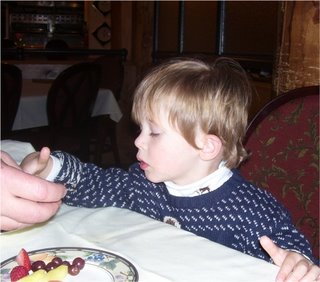 Our soup, a small and reasonable portion, followed. It too was delicious, only the broth a touch too spicy for our son - so he picked out the vegetables and sausage to eat, leaving the broth behind. This was followed by another quick trip up to graze the salads - some tomatoes-basil-mozzerella, olives, sliced melons, grapes, strawberries and pineapple proved to be winners.
The entrees followed, beautifully presented, equally delicious - and as stated, portions served as portions should be - just enough to enjoy without the need for a wheelbarrow to carry out the leftovers! Dessert, nah! - we were quite content after this feast, nibbling on the last bits of fruit and cheese, and passed on the delicious sounding desserts offered; awaiting our small doggie-bag (a leak-proof box actually) to arrive with our bill.
My reason for these details?
No other child in the restaurant that afternoon was eating anything other than the bowl of noodles and cheese, a bowl that contained no less than six cups of pasta, I'm telling you, it was HUGE, glimmering with butter and parmesan cheese. Every child under five, it seemed, was left to mull over this super-size bowl of noodles while their parents enjoyed the incredible meal.
Surely with the cheeses, fruits, salads, speads and entrees (that included a wonderful assortment of baby vegetables as the side) these kids would find something they liked and would eat, no? In this restaurant, it wasn't a matter of enticing rock-bottom price - whether we chose the noodles or the complete menu, the price was the same. So, why would anyone not choose the full-menu and encourage their children to at least try this wide assortment of well-prepared, fresh, delicious food?
Somehow I think we've come to believe our children will not eat such food; they're picky eaters and prefer the known over the unknown. In some ways this is true; moreso if you do not encourage a wide variety of flavors, tastes and textures early on. The "kid's menu", I believe, reinforces the notion that children will only eat a very limited selection of foods.
Can you imagine, that no matter where you go to eat out - italian, chinese, mexican, indian, american, steakhouse, seafood, thai, french, lebanese, middle eastern, or other yummy sounding restaurant - you're given just four choices, actually the same four choices, every time you eat out? Chicken nuggets, burgers, noodles, pizza - again and again, everywhere you go, every restaurant you're taken to eat.
Is it any wonder our children's most often eaten foods are fries, pizza, burgers, pasta and chicken nuggets?
We're teaching them that's what you eat, what they're to eat, every time we eat out and once again order something for them from the "kid's menu."
Personally, I don't see us ever ordering off the kid's menu - thus far, this decision has served us well; our son enjoys eating out, is continuously trying new foods, and we've yet to not find something on the menu we're going to order that isn't something he'll eat too. Over the holidays, we dined at a local steakhouse with visiting family - an extra side of aspargus (cooked tender) was added to our order simply because it's one of our son's favorites and didn't come with any of the entrees. His plate was filled with a selection of our meal, along with his asparagus and some of our vegetables.
The kid's menu at that restaurant? Burgers, chicken nuggets or pizza. No bowl of noodles, but I bet if we'd asked, they would have made them!
Childhood obesity is on the rise and I have to wonder if, with all the meals eaten away from home these days, if part of the problem isn't so much the eating out part, but the never-changing, always the same meals - the same junk food everywhere and anywhere you eat out - encouraged by almost every restaurant in America, found again and again the kid's menu?
While these items may appeal to the budget, what are they really teaching our children about eating?
Since my son was born, my husband and I have almost always taken him out to eat with us. It's very rare he doesn't accompany us.
I can still recall one of our first dinners out when he was finally predictably and regularly eating solid food, he was 10 or 11-months old - we ate at Lebanese Taverna in Arlington, VA.
Seated at the next table was another couple with their little girl, who was probably 2, and a delight - well behaved, laughing happily as her parents engaged her and enjoyed their dinner. What struck me as somehow sad was her meal - deep-fried, breaded chicken fingers with french fries.
Here her parents had an incredible opportunity to provide a wonderful and delicious new taste experience for her, and they instead chose to order the same-old, same-old, available on every kid's menu in America - chicken nuggets and french fries.
That night, my son dined on tastes of everything we were eating - Hummus bel Shawarma, Mixed Shawarma and Sharhat Ghanam. Portion sizes being what they are these days, it was more than enough for the three of us, with leftovers taken home in a doggie-bag!
In almost every restaurant we're eaten in, it's the same story - the kid's menu is often a repeat from the last restaurant - chicken nuggets, noodles with butter (and sometimes even cheese), pizza or bugers (with and without cheese) - with a side of french fries or other potato concoction (think tater tots), a beverage and often a dessert too; all for a rock-bottom price that's hard to pass up!
Is it any wonder our children's most often eaten foods are fries, pizza, burgers, pasta and chicken nuggets? It's all we offer them each and every time we order off the kid's menu!
On our recent vacation in Colorado, we had lunch at Alpenglow Stube (young children are discouraged from the dinner hour). This gave us an opportunity to bring him up to the summit on a gondola, and as luck would have it, a snow cat ride down the mountain after lunch since the winds picked up and the gondola was closed due to high winds.
Lunch is a pre-fixe menu that included a starter buffet wtih a sampling of cheese, crackers, breads and spreads from around the world, followed by a choice of homemade soup, then a second buffet of salads, fruits, and other selections before the entree was finally served. On the day we were there our soup selections were either coconut-chicken-curry or wild boar sausage in a tomato and vegetable base; our entree selections were rack of lamb or a surf-and-turf combo of grilled venison and shrimp.
Some pretty daring stuff to consider for a toddler!
As we read the menu and options, we were told our son might prefer noodles with butter, an item not listed on the menu; then it was added, we could also choose off the menu if we preferred, assured that portion sizes were small anyway.
Decisions, decisions...
No decision really - our son hasn't had a meal off a kid's menu in a restaurant - so it was the wild boar soup for him and me (coconut-chicken-curry for my husband) and grilled venison and shrimp for him; rack of lamb for both my husband and me.
A quick trip to the cheese buffet started our delicious lunch with feta, goat, blue, cheddar and brie, a small assortment of crackers and some unidentified (but interesting looking) spreads. The only cheese not eaten by my son - the blue, which was quite tangy, with quite a "bite" to it; understandable that a two-year-old might not find it palatable!
 Our soup, a small and reasonable portion, followed. It too was delicious, only the broth a touch too spicy for our son - so he picked out the vegetables and sausage to eat, leaving the broth behind. This was followed by another quick trip up to graze the salads - some tomatoes-basil-mozzerella, olives, sliced melons, grapes, strawberries and pineapple proved to be winners.
The entrees followed, beautifully presented, equally delicious - and as stated, portions served as portions should be - just enough to enjoy without the need for a wheelbarrow to carry out the leftovers! Dessert, nah! - we were quite content after this feast, nibbling on the last bits of fruit and cheese, and passed on the delicious sounding desserts offered; awaiting our small doggie-bag (a leak-proof box actually) to arrive with our bill.
My reason for these details?
No other child in the restaurant that afternoon was eating anything other than the bowl of noodles and cheese, a bowl that contained no less than six cups of pasta, I'm telling you, it was HUGE, glimmering with butter and parmesan cheese. Every child under five, it seemed, was left to mull over this super-size bowl of noodles while their parents enjoyed the incredible meal.
Surely with the cheeses, fruits, salads, speads and entrees (that included a wonderful assortment of baby vegetables as the side) these kids would find something they liked and would eat, no? In this restaurant, it wasn't a matter of enticing rock-bottom price - whether we chose the noodles or the complete menu, the price was the same. So, why would anyone not choose the full-menu and encourage their children to at least try this wide assortment of well-prepared, fresh, delicious food?
Somehow I think we've come to believe our children will not eat such food; they're picky eaters and prefer the known over the unknown. In some ways this is true; moreso if you do not encourage a wide variety of flavors, tastes and textures early on. The "kid's menu", I believe, reinforces the notion that children will only eat a very limited selection of foods.
Can you imagine, that no matter where you go to eat out - italian, chinese, mexican, indian, american, steakhouse, seafood, thai, french, lebanese, middle eastern, or other yummy sounding restaurant - you're given just four choices, actually the same four choices, every time you eat out? Chicken nuggets, burgers, noodles, pizza - again and again, everywhere you go, every restaurant you're taken to eat.
Is it any wonder our children's most often eaten foods are fries, pizza, burgers, pasta and chicken nuggets?
We're teaching them that's what you eat, what they're to eat, every time we eat out and once again order something for them from the "kid's menu."
Personally, I don't see us ever ordering off the kid's menu - thus far, this decision has served us well; our son enjoys eating out, is continuously trying new foods, and we've yet to not find something on the menu we're going to order that isn't something he'll eat too. Over the holidays, we dined at a local steakhouse with visiting family - an extra side of aspargus (cooked tender) was added to our order simply because it's one of our son's favorites and didn't come with any of the entrees. His plate was filled with a selection of our meal, along with his asparagus and some of our vegetables.
The kid's menu at that restaurant? Burgers, chicken nuggets or pizza. No bowl of noodles, but I bet if we'd asked, they would have made them!
Childhood obesity is on the rise and I have to wonder if, with all the meals eaten away from home these days, if part of the problem isn't so much the eating out part, but the never-changing, always the same meals - the same junk food everywhere and anywhere you eat out - encouraged by almost every restaurant in America, found again and again the kid's menu?
While these items may appeal to the budget, what are they really teaching our children about eating?
Wednesday, January 17, 2007
You Can't Fool Mother Nature
Last month I took quite a beating in email when I posted Big Brother Takes Job as Short-Order Cook.
In it I questioned what restaurantuers would replace industrial trans-fats with, and provided a short list of contenders being promoted in the marketplace. I also said "I'd bet that this government-enforced decline in trans fat consumption in restaurants will be matched by something as just as bad, if not worse (considering our apriori obsession with total dietary fats and condemnation of dietary saturated fat), although we'll feel good that we're not allowing any appreciable trans-fats to be served to anyone eating in a New York this time around, and we'll continue to be ever-vigilant about those dreaded saturated fats because we can be sure the watchdogs will be out in force to make sure no one uses them to replace partially hydrogenated fat in food preparation!"
On things like this, I hate being right.
Just released yesterday: New fat, same old problem with an added twist?
Study shows a new fat replacement for trans fat raises blood sugar in humans
Waltham, MA -- Last month, New York City outlawed the use of partially hydrogenated oils, known as trans fats, in restaurants, a ban now under consideration in other cities, including Boston and Chicago. But novel research conducted in Malaysia and at Brandeis University shows that a new method of modifying fat in commercial products to replace unhealthy trans fats raises blood glucose and depresses insulin in humans, common precursors to diabetes. Furthermore, like trans fat, it still adversely depressed the beneficial HDL-cholesterol.
Published online in Nutrition and Metabolism (http://www.nutritionandmetabolism.com/), the study demonstrates that an interesterified fat--(a modified fat that includes hydrogenation followed by rearrangements of fats molecules by the process called interesterification) enriched with saturated stearic acid--adversely affected human metabolism of lipoproteins and glucose, compared to an unmodified, natural saturated fat. Interesterification to generate a stearic acid-rich fat is fast becoming the method of choice to modify fats in foods that require a longer shelf life because this process hardens fat similar to oils containing trans-fatty acids. The new study shows that interesterification, which unnaturally rearranges the position of individual fatty acids on the fat molecule, can alter metabolism in humans.
"One of the most interesting aspects of these findings is the implication that our time-honored focus on fat saturation may tell only part of the story," explained biologist and nutritionist K.C. Hayes, who collaborated on the research with Dr. Kalyana Sundram, nutrition director for palm oil research at the Malaysian Palm Oil Board in Kuala Lampur.
"Now it appears that the actual structure of the individual fat molecule is critical, that is, the specific location of individual fatty acids, particularly saturated fatty acids, on the glycerol molecule as consumed seems to make a difference on downstream metabolism of fat and glucose," said Hayes. Both Hayes and Sundram are experts on human lipid metabolism and were instrumental in the development of Smart Balance® Buttery Spreads, a blend of vegetable oils that improves the cholesterol ratio.
Trans-fatty acids, which became ubiquitous in baked goods, processed foods and restaurant cooking decades ago because of their shelf life and other properties, are now being abandoned by many producers of commercial products such as cookies, crackers, pies, doughnuts, and French fries because they raise LDL ("bad") cholesterol, lower HDL ("good") cholesterol and contribute to heart disease.
The Malaysian-Brandeis collaboration compared trans-rich and interesterified fats with an unmodified saturated fat, palm olein, for their relative impact on blood lipids and plasma glucose. Thirty human volunteers participated in the study, which strictly controlled total fat and fatty acid composition in the subjects' diet. Each subject consumed all three diets in random rotation during four-week diet periods. This study further confirmed previous studies in animals and humans, indicating once again that trans fats negatively affect LDL and HDL cholesterol. Surprisingly, the interesterified fat had a similar, though weaker impact on cholesterol.
"In this study we discovered that trans fat also has a weak negative influence on blood glucose. The newer replacement for trans, so-called interesterified fat, appears even worse in that regard, raising glucose 20 percent in a month," said Hayes.
"This is the first human study to examine simultaneously the metabolic effects of the two most common replacement fats for a natural saturated fat widely incorporated in foods. As such, it is somewhat alarming that both modified fats failed to pass the sniff test for metabolic performance relative to palm olein itself," noted Sundram.
"Whether this reflects the amount of test fat consumed, underlying genetics of the specific population examined, or some unknown factor, requires further study because the apparent adverse impact on insulin metabolism is a troubling finding," he added.
Parents in the Crosshairs Again...
News Item: Two convicted for making pet dog obese
Consumer advocate Mike Adams says more cases like this should be brought against the parents of children, not just pets. "Isn't it interesting that the courts are ruling it's illegal to make your dog obese, but it's perfectly okay to make your children obese by feeding them junk foods and sugary drinks?"
Are we as a society really coming to this?
"Take a Peak" to take consumers for a ride
The three leading trade associations in the processed food sector, the Grocery Manufacturers Association (GMA), the Food Products Association (FPA) [GMA and FPA are now one and the same]; and the Food Marketing Institute (FMI) have teamed up with MatchPoint Marketing to roll out Take a Peak in grocery stores across the US to convince us to eat according to the 2005 Dietary Recommendations for Americans and MyPyramid.
This thinly veiled marketing ploy is being touted by the media as a program to help consumers; where "consumers will find aisle banners, kiosks and other displays in stores that will help point them to fare that is consistent with the dietary guidelines."
As Sally Squires writes in the Washington Post, "The new displays will help put the government's message in front of shoppers as they roll their carts down grocery aisles."
Oh goody!
A quick review of MatchPoint Marketing's website page "about" tells us exactly what to expect, "If commerce is the engine that drives our economy, then MatchPoint Marketing is the spark. We ignite demand. We take consumers by the hand and lead them toawrd the ultimate goal - making the cash register ring."
This isn't a small, trial-it-out campaign, it's well designed to completely overwhelm the senses - in stores you'll be innundated at every turn with aisle banners and signs, kiosks, tip cards, floor graphics, shelf signs pointing to products, manufacturer displays and even custom bags at the register check-out.
Repeat the message often enough and it becomes truth; overwhelm the senses at it can happen at lightening speed.
Wednesday, January 03, 2007
Happy New Year!
It may not need saying, but this year was wonderfully hectic here at Wilshire Central - we've enjoyed a visit from my parents, a visit from my inlaws, hosted our first big party in our new house, hosted another smaller get together this weekend, and are now getting ready for a much needed vacation! So, while I've only had time to post a couple of articles the last couple of weeks, you'll have to forgive my continued absence from the blogosphere until January 15th, when I'll be back from vacation and ready to settle back into life as we know it after the holidays.
For now let me direct your attention to some interesting posts and headlines you may be interested in reading....
Derek A. Paice maintains a free e-book online, Diabetes & Diet (PDF), that details his experience controlling type 2 diabetes with diet. It's a fascinating read and chronicles his success in bringing his A1c from 9.0 in 1993 to 5.4 in 1997 to 5.2 in 2000. No matter what your opinion about carbohydrate restricted diets or glycemic index-load diets - this is worth reading to understand the value of testing, testing, testing and using that data to make adjustments to your diet based on how your body reacts to various foods - also known as eating to your meter!
The People Magazine cover story this month is about people who lost weight; one woman, Mary Smith, lost 125-pounds using a low-carb diet (Atkins) as her weight loss approach. The People Magazine site also includes a video of all the individuals featured in the cover story.
For some reason we love the idea of a paradox - the French Paradox, the Spanish Paradox and the Swiss Paradox are all ways we try to explain why some populations eat a diet so contrary to our dietary dogma, yet remain healthy and live longer than we. Discover Magazine has an article, The Inuit Paradox, that explores the traditional diet of the Inuit - and, like the other paradoxes, sets the stage that this society thrives despite their diet, rather than because of their diet; "Today, when diet books top the best-seller list and nobody seems sure of what to eat to stay healthy, it’s surprising to learn how well the Eskimo did on a high-protein, high-fat diet." Setting aside the assumptions the article makes, if you're interested in learning just how the Inuit eat (traditionally) this is a must read!
While some may feel my position - that government regulation is not the solution to our obesity epidemic - take a gander at this article that highlights the scary ideas some have come up with to reverse the obesity epidemic! Gillian McKeith, an anti-obesity campaigner, had proposed, in addition to mandatory school lessons for children and tax breaks for the slim, that "nutritional hit squads" be deployed into private homes of obese people to clean out their pantry, cupboard and refridgerator to get them to eat healthy! Government ministers in Scotland rejected the idea.
Dr. John Salerno has joined the ranks of bloggers with his new blog, The Salerno Strategy. He's a board-certified Family Practice physician who brings 15-years of experience in Family Medicine and Complementary Medicine to his blog.
So....now I'm off for what I'm certain will be a great vacation and I hope you'll check back again on January 15th when I'll resume writing and posting here!
Happy New Year!
Friday, December 29, 2006
Tag - I'm It!
What might you find interesting about me that you wouldn't know if I didn't tell you?
That's the concept of playing tag online - if you're tagged, you reveal five little known things about yourself and then get to tag five other people to do the same. Suzique, over at the Low-Carb Lab recently tagged me in her No-No-NOLA blog...I'm game, how about you?
Little known things about me:
1. I have Fred Flintstone feet. Enough said.
2. Once, years ago, I had a bowl of M&M's on my desk for so long, untouched, they collected dust -- ewww. Yup, I can sit for days/weeks/months with a bowl of M&Ms next to me and not eat one of them - and it's not like I don't like them, they're okay, it's just I've never been a big fan of milk chocolate, so it's not tempting to me....really good dark chocolate, that's another story.
3. I'm a PADI certified Open Water Diver and my favorite SCUBA spot (so far) is off Maui, Hawaii - the waters around Molokini are pristine and home to more than 250 species of fish to see while diving to depths up to 150-feet (I only dove to 60-feet).
4. I've been to Pakistan - to attend a wedding - and was able to visit Karachi, Islamabad, Bourbon and Taxila...a very cool vacation! And the weddings there are a lot of fun - they last for days and days, with parties for every reason you can think of to have a party; bride-to-be is getting married, let's have a party, groom-to-be is getting married, let's have a party, oh - the couple together needs a party too, the brides and grooms parents have a party, the wedding is followed by a party, the reception - yup, another party!
5. I was a competitive hunter and show jumper growing up - pretty darn good too! In my best year I made it to the finals in an attempt to qualify for the New York Horse Show.....but, somehow, I actually managed to disqualify myself by falling off my horse on the simplest of all jumps - I fell at the first cross-rails in a six bar competition, the lowest jump on the course!
...and life goes on without a ribbon from the Garden!
Who shall I tag?
Who might be up to the task that you might also enjoy learning something new about?
Tag, you're it - Mike Eades, Jonny Bowden, Lou Shuler, John Briffa and, last but not least, Richard Morris.
Saturday, December 23, 2006
Tuesday, December 19, 2006
Study: Six Weeks from Normal to Pre-Diabetic
A study, Effect of Eucaloric High- and Low-Sucrose Diets With Identical Macronutrient Profile on Insulin Resistance and Vascular Risk, published in the American Diabetes Association (ADA) journal, Diabetes, investigated the relationship between sugar intake and risk of developing diabetes.
What's fascinating, and disturbing at the same time, is how this study made it through peer-review without questioning the conclusion that a high-sucrose intake as part of a balanced, eucaloric, weight-maintaining diet had no detrimental effect on insulin sensitivity in healthy nondiabetic subjects compared with a low-sucrose diet; when the data clearly shows subjects at baseline had a normal fasting blood glucose level of 4.8mmol/L (86.4mg/dL) which rose to the ADA defined pre-diabetic level, 100-125mg/dL, rising to 5.6mmol/L (100.8mg/dL) in just six weeks.
The subjects' HOMA-IR score also climbed from a reported 1.99 at baseline to 2.14 when assigned the diet containing 10% sucrose, and to 2.39 when assigned the diet containing 25% sucrose, after just six weeks on either diet. The HOMA-IR, you'll recall, is the Homeostasis model assessment for Insulin Resistance. A value greater than 3.8 is indicative of insulin resistance. It is calculated by using the formula: HOMA-IR = insulin (µU/mL) × glucose (mmol/L) ÷ 22.5.
Over a period of just six weeks, the subjects in this study experienced a rise in their HOMA-IR scores and their fasting blood glucose, yet the researchers concluded "a high-sucrose intake as part of a balanced, eucaloric, weight-maintaining diet had no detrimental effect on insulin sensitivity in healthy nondiabetic subjects compared with a low-sucrose diet."
Even the headlines are trying to convince us this study somehow proves sugar doesn't cause diabetes - Sugar not linked to diabetes rise, suggests study.
In the above article we're told, "Writing in Diabetes, Dr. Hunter and his co-workers report that no weight changes were recorded for either group, and that there was no significant differences in glucose uptake and production. Additionally, no significant adverse effects for a number of other metabolic and physiologic parameters were observed between the groups, he said, such as elasticity of the arteries, and glycaemic profiles."
In this study, a high-sucrose intake as part of an eucaloric, weight-maintaining diet had no detrimental effect on insulin sensitivity, glycaemic profiles, or measures of vascular compliance in healthy non-diabetic subjects," said the researchers."
It is likely that other dietary factors such as excess calories and lifestyle factors such as physical inactivity and weight gain may be more important than carbohydrate type," said Hunter."
How exactly does a finding, completely at odds with the data, get published? I have to wonder, are these conclusions and subsequent headlines because "This study was supported by an unrestricted research grant from The Sugar Bureau and Suikerstichting, the Netherlands."?
Let's hypothetically say the source of funding did somehow influence the conclusions for a moment - shouldn't the peer-review process, prior to publication of the paper, caught that the data showed progression to pre-diabetes in healthy subjects in just six weeks?
Seriously - it took me less than five minutes to see the red flags - both missing and ignored data.
The missing data red flag - in the study, the researchers calculated and included the baseline HOMA-IR yet did not do so in the final data or mention the HOMA-IR after the two diets in the paper. Why?
The ignored data red flag - the rise in fasting blood glucose from baseline to the six week endpoint in the two diets. Why?
I'm no expert in diabetes, but even I know that rising fasting blood sugars that rise from normal to pre-diabetic levels, and an increase in HOMA-IR, in just six weeks, is not a good thing; and certainly not indicative that the diet studied is benign, having no effect on the metabolism of glucose.
But, hey, we're told once again sugar doesn't cause diabetes.
You want to know something? It's true - it doesn't. It's not the sugar per se, it's the excessive total carbohydrate that includes sugar and starch in the diet.
In both diets subjects increased total carbohydrate from 280g a day (17g of fiber) to 437g a day. After just six weeks, the difference between the 437g carbohydrate diets with 10% sucrose or 25% sucrose was insignificant, but the difference from a baseline diet with 280g of carbohydrate compared with the trial diets containing 437g of carbohydrate should be a wake-up call for anyone investigating how insulin resistance and pre-diabetes, which places one on the road to develop diabetes, can happen in just six weeks.
It's right there in the data - fasting blood glucose rose in six weeks from normal to pre-diabetic -- and not one researcher or peer-reviewer saw fit to highlight that fact.
Ignore the data at your own risk.
Friday, December 15, 2006
A Gallon of Soda a Week!
That's what the latest figures from the Census Bureau say each American drinks, on average, each week.
1454-calories a week, just from soda!
375.7g carbohydate a week, just from soda!
54g of carbohydrate a DAY, just from soda!
13.5-teaspoons of sugar a DAY, just from soda!
1454-calories a week, just from soda!
375.7g carbohydate a week, just from soda!
54g of carbohydrate a DAY, just from soda!
13.5-teaspoons of sugar a DAY, just from soda!
Santa is too Fat!
We've taken away Cookie Monster's cookies, said Candyland might contribute to childhood obesity so maybe kids shouldn't play it, and banned cupcakes from school birthday parties. Just when you thought it wasn't possible to suck the life out of childhood anymore than we've already done, now we need to make Santa lose weight.
As reported in the Scotsman, Santa Claus is too fat and a poor role model for children!
THE festive image of a fat, jolly Santa could be sending out the wrong message in the fight against obesity, experts warned yesterday.
[...]
Dr Miles Fisher, consultant physician at Glasgow Royal Infirmary, said: "Santa is the archetypal picture of abdominal obesity."
He added: "The image of Santa is of a round, jolly person and it is meant to be one of hilarity, but if you have obesity around your tummy, then it is very bad for you. "
Before, we thought it was just not good to be overweight, but now we know that having fat around your middle is particularly bad."
Attitudes toward Overweight and Obese
"Why should the whole population basically pay for the preventable actions which other people choose?"
That was the question posed by Paul Frijters of the Queensland University of Technology as he introduced a "user pays" principle to curb the escalating costs of healthcare associated with the obesity epidemic in Australia.
Professor Frijters urged the Federal Government to lift restrictions on health insurance companies to ask questions about a person's weight and allow them to calculate increased premiums based on body mass index.
Obesity has been linked to a number of life-threatening conditions such as type 2 diabetes, high blood pressure and heart disease.
"There's a much heavier use of medicine and there's much heavier use of hospital care by obese people," Professor Frijters said. "Obesity is so closely related to lifestyle choices and the costs associated with it are becoming so great that it's no longer tenable to simply gloss over it."
In the UK, the media is hot on the warning that obesity could bankrupt the healthcare system in that country.
Professor Sattar, an expert in metabolic medicine, said research had linked obesity to a range of diseases and disorders, including heart disease, cancer, depression, back pain, diabetes and skin problems. He said: "The problem of rising prevalence in obesity may get much worse - rates could climb still further, bankrupting the health system and leading soon to reductions in life expectancy. "So we need to think out of the box, nothing that has been looked at so far seem to have worked."
He said while individuals "clearly have some responsibility for their health", the rest of society should also play more of a role. He said the food industry should own up to the role they play through advertising and schools should be doing more to promote good diets and lifestyles.
Among the ideas put forth to help individuals take some responsibility - warning labels on larger size clothing with a phone number to call a helpline!
I kid you not!
The number should be promoted on the labels of all clothes sold with a waist of more than 40in (102cm) for men, 37in (94cm) for boys, 35in (88cm) for women, and 31in (80cm) for girls.
What's happening here in the states?
Well, from Texas we find this interesting opinion, "Then I stopped and thought — for every person who doesn’t have insurance and spends their time jamming unhealthy foods down their gullet, there’s a cost. When they wheel portly New Yorkers into the hospital with a burrito in one hand and a donut in the other — there’s a cost.
I don’t want the government controlling my life — but I also don’t want it to keep dipping into my pocket because someone else continues to make a stupid mistake that will cost themselves their life and the rest of us millions — if not billions — of dollars."
From Milwaulkee there's this - "None of my columns has elicited the wrath of the masses. I'm about to change that. Because statistically speaking, it's a pretty good bet for me to say that you're fat. And I'm ticked off because you're hurting my wallet.
People often ask how I stay so skinny. It's true; compared to most people I encounter on a typical day, I look like a rail. But according to the chart for body mass index, my current height and weight (6'1, 155 pounds) fits within the ideal BMI parameters.
What's my secret? And why am I ticked off that a big portion of my paycheck goes to treating obesity-related illness? Because my being skinny is not an accident; I have to work at it. During the past 13 years, I've run enough miles - more than 25,000 - to circle the Earth. When that damaged the tendons in my foot, rather than sit and mope, I hit the weight room, took up swimming, bought a bike and, if nothing else, took 60 minutes or more each day to walk. Though I have a weakness for chocolate, a look into my typical grocery cart reveals things like broccoli, spinach, multigrain bread and apples. My alcohol consumption is usually no more than one drink a week. Fast food? Strictly reserved for my few trips a year back home to Minneapolis. In other words, I make the choices necessary to avoid obesity-related illness."
And, a recent survey, reported in Insurance News Net found "more than 25% of Americans are comfortable with charging obese people higher premiums for their benefits."
Clothing with warning labels? Higher premiums based on BMI? Obese people choose to be fat?
What do you think?
Thursday, December 14, 2006
Big Brother Takes Job as Short Order Cook
Last week New York City became the first major city to approve a ban on industrial trans-fats in restaurant food preparation. As the mayor of New York, Michael R. Bloomberg, was quoted in the New York Times, the city is ''not going to take away anybody's ability to go out and have the kind of food they want, in the quantities they want. We are just trying to make food safer."
The mayor is also quoted on MSNBC as saying “Nobody wants to take away your french fries and hamburgers — I love those things, too, but if you can make them with something that is less damaging to your health, we should do that.”
What's to argue here? It's clear industrial trans-fats, created in a process to convert liquid oil to a stable solid fat by hydrogenation, are bad for us; they lower HDL, raise LDL, and data shows they contribute to inflammation and elevated risks of coronary heart disease.
Besides the known health risks, a wide range of leading health organizations, including the American College of Cardiology, the American Cancer Society, the American Diabetes Association, the American Medical Association, the American Society of Hypertension, the Medical Society of New York and the New York Academy of Medicine all support the ban.
Heck, even my thoughts upon hearing the news of the ban was positive.
That is until I thought about it and considered the potential long-term implications of this type of ban - a ban on a legal food ingredient that no one is forced to consume. Ever.
Sorry, but the argument that consumers have no choice because restaurants are using the ingredient unbeknownst to them doesn't hold water - you'd have to be living under a rock to not know partially hydrogenated oil is the oil of choice for making french fries, pastry and baked goods in the United States; and your taste buds would need to be non-functional to not taste the margarine instead of butter on the vegetables, potatoes or bread.
Besides that, no one makes you eat out - you choose to and you have the choice to spend your money at establishments that use these partially hydrogenated fats or spend your money at establishments that don't.
One issue on my mind, in considering the long-term implications, is the fact that these fats were lobbied into our food supply on a large-scale by the very same people now insisting they be banned - yes, the same people now telling us to stop eating trans-fats once upon a time insisted they were "healthier" for us than the fats traditionally used in food preparation.
For that history, you can read Dr. Mary Enig's article, The Tragic Legacy of the Center for Science in the Public Interest, penned three years ago, that detailed how CSPI led the way, by public relations blitz, to pressure restaurants to replace the oils traditionally used with partially hydrogenated oils. All in the name of improving the quality of our food and health!
This is the same organization that, back in 1988, in their newsletter, declared that "the charges against trans fat just don't hold up. And by extension, hydrogenated oils seem relatively innocent." Today, the Executive Director of CSPI, Michael Jacobson now claims trans-fats kill 30,000 people each year. He's the same Michael Jacobson that led the way back in the eighties to, shall we say, "motivate" restaurants to replace their oils with partially hydrogenated oils.
As an Op/Ed in the Wall Street Journal asked, "We wonder if he feels guilty?"
But let's put that aside. Let's give him the benefit of the doubt (shrug) that he didn't know, couldn't have known (big eye roll) and was really of the assumption that he was doing the right thing (sigh).
The ban leaves way too many questions unanswered.
Topping the list, what will now replace the partially hydrogenated oils?
You can be damn sure no one is going to even consider going back to what worked - naturally saturated fats like coconut oil, butter, beef tallow, lard or palm oil. Who is going to risk the public outcry if they even consider these oils, let alone actually use them? We absolutely have to ignore that they undergo significantly less damage when heated, hold up extremely well in high heat applications and produce an end product that often tastes better than those made with partially hydrogenated oil. Good grief, they're saturated fats! No can do!
So, then, what's out in the pipeline of options?
Well, let's see:
zTrim is one handy-dandy fat replacement, made of "an insoluble fiber made from corn and oat."
"The ingredient and the process are the brainchild of George Inglett, longtime researcher at USDA’s Agriculture Research Service labs in Peoria, Ill. The USDA licensed the rights to this all-natural grain to Fibergel Technologies, Inc., a wholly owned subsidiary of Z Trim Holdings, Inc."
Thank you USDA...more corn in our diets.
Food Processing magazine offers up some more "yummy" industrial options:
Rebalance System Satin 50
"a combination of thickeners, texture enhancing ingredients and Splenda sucralose for use in salad dressings, sauces and marinades. Manufacturers can reformulate the above mentioned items to achieve lower calories and/or reduced fat."
NovaLipid line of fats and oils
"Each one is specifically formulated to contain little or no trans fat. NovaLipid products have an extremely low taste profile, making them a suitable addition or alternative to a vast number of food applications such as shortenings, margarines, confections and many other prepared foods."
Neobee MLT-B
"a structured lipid based on medium-chain triglycerides (MCTs). It’s a suitable replacement for partially hydrogenated vegetable soil (PHVO). Designed to mimic the solid fat index of PHVO in baking applications, the product incorporates the dietary and health benefits of MCTs, which are metabolized in one-eighth of the time and deliver fewer calories than typical long-chain fats."
Clear Valley 65
"a high oleic canola oil brings superior performance to hydrogenated shortenings, and superior fry stability and improved fry flavor."
Nexsoy Trans Fat-Free
"an expeller-pressed soybean oil. It is manufactured without the use of chemical solvents or refining caustics. It has the stability of partially hydrogenated soybean oil but is free of unhealthy trans fats. It can be used in commercial frying applications, snack foods, dressings and sauces..."
And you thought Crisco was nasty stuff?
So, which of the above options will the restaurant you eat at use?
Or will they choose something else?
Who knows?
Who cares, trans-fats are banned, anything replacing them will be "healthier," right?
There's the fatal flaw in this idea that banning trans-fats from restaurant foods is going to lead to healthier foods and healthier lives of citizens consuming those foods. It's absurd to think we can regulate and legislate away our obesity epidemic, our alarming rates of diabetes and our suseptibility to chronic, degenerative disease. None of these laws change the one thing that is required to lose weight and prevent health problems - human behavior.
Everyone in New York knows you can't make someone stop eating french fries if they're so inclined - even Mayor Bloomberg conceeds he's not taking away your french fries - they're just going to be fried in something else, again.
So really, what's the point?
This ban isn't going to make New Yorkers healthier, fitter or eat less french fries or other calorie-rich, nutrient deficient food. I'd bet that this government-enforced decline in trans fat consumption in restaurants will be matched by something as just as bad, if not worse (considering our apriori obsession with total dietary fats and condemnation of dietary saturated fat), although we'll feel good that we're not allowing any appreciable trans-fats to be served to anyone eating in a New York this time around, and we'll continue to be ever-vigilant about those dreaded saturated fats because we can be sure the watchdogs will be out in force to make sure no one uses them to replace partially hydrogenated fat in food preparation!
But those consequences pale in comparison to the very real loss of personal liberty.
Think about it - what right does the government have to summarily ban trans fats from food preparation by restaurants when they're still readily available next door at the corner market?
Ahhhh, wait a minute....maybe that should be the next stop - ban foods with these nasty fats from the shelves; the current requirement for disclosure on nutrition labels is simply not enough to protect consumers from themselves and their indulgent ways!
In fact, there are still lots policies and bans that health officials have not yet proposed - if banning one food ingredient is really such a good way to promote health, why don’t we just pull out all stops and ban beef, bacon, coffee, sugar, salt, alcohol, mayonnaise, cream, butter, and whole milk products while we're at it? That way very few people could buy these "health damaging" foods. That would surely end the obesity epidemic pretty quickly, wouldn't it?
Yeah, that's the ticket, more regulation!
While I am being a bit snarky here, I personally have no arguement about the health damaging effects of industrial trans-fats - in fact, I would love to see them eliminated fully from the food supply. What's utterly insane is a city council selectively banning their use in one segment of the economy - restaurants - while they remain freely available elsewhere, while they tell us the ban is to protect and improve our health.
Honestly, the only real basis for serious opposition to such a ban is one fundamental principle - respect and value of individual freedom to act and judge with his/her own mind.
What the ban in New York shows us, quite clearly, is that it's easy to ban something everyone agrees is "bad" for us. Nothing else is required to put an end to its consumption other than "we know it's bad for our health" - forget cognition on the part of the individual consumer, no choice or decision making on his part in these trifling matters counts for anything according to the New York City Board of Health and its experts.
The freedom to choose can simply be ignored and brushed aside because the government knows better, and knows how to protect you from yourself, and your consumption of a legally available food ingredient.
Hey look - Chicago was quite miffed New York beat them to a ban on trans-fats; they're now looking at not only banning trans-fats, but also offering up an ordinance aimed at healthy living, a requirement that would mandate prominent posting of the calories, sodium and saturated fat content of each menu item offered at chain restaurants.
Nope, not trans-fat, but saturated fat.
This, of course, to "protect the children" - as Alderman Burke said, "I don't think adults necessarily have to be controlled, they make their own lifestyle choices whether it is eating, drinking or smoking, but when it comes to kids I think every medical expert would agree that something needs to be done. If you look at the statistics now about child obesity, the early onset of child diabetes, the early onset of cardiovascular problems with children, you will find it is of epidemic proportions in America. I think parents ought to be a little bit more aware of what their kids are eating."
Like we aren't already aware?
I ownder, where will this slippery slope will bottom out?
Some will believe government is "looking out for our good," but ask yourself if you can manage this on your own.
Wednesday, December 13, 2006
Letter to Editor Sees Light of Day...
Last week The Oregonian published A Jazz Man's New Groove, about Thara Memory, a jazz trumpeter who lost a leg and finger to complications of diabetes "but not his fire to make music."
It wasn't an article that caught my attention in my daily review of the news; in fact, I probably wouldn't have known of it if it weren't for a reader of my blog bringing it to my attention. Vivki A. emailed me because she'd sent a letter to the editor of the Oregonian about the article. That was last week. The editors have not indicated they'll be publishing her letter, so I decided I'd publish it for her.
Dear Editor,
Your story headlined "Diabetes steals Thara Memory's [a well known local trumpet player] lower leg and fingertip" make me feel so sad - and angry. It would better have been headlined "Memory hands his lower leg and fingertip to diabetes".
No, I'm not blaming Thara Memory for the loss of his lower leg and fingertip. I'm blaming his doctors, who gave him such bad advice about diabetes management that he had no alternative but to lose those limbs, plus his kidneys, forcing him on dialysis and making him an invalid with a severely restricted lifestyle.
These diabetic-related complications could have been entirely avoided had his doctors given him the proper tools - which they obviously did not.
If his doctors were like the vast majority, they probably gave him some pills, told him to lose weight, gave him a copy of the ADA diabetic diet plan and sent him on his way. They might have told him to test 2 or 3 times a day without telling him what to do with the results of that testing. And maybe even told him he had "excellent" control when his A1C(an average of blood glucoses over a 3-month period) was 7 or even anywhere near that number.
What they probably didn't tell him was that if he could get his A1C to under 6.5 he very likely wouldn't have lost the use of those limbs. Or the use of his kidneys. Or be wheelchair bound. Nor did they tell him how to do this.
Although it takes some effort, it can be done. I have, and I know many diabetics who have.
I blame the American Diabetic Association, whose diet plans almost all doctors give their diabetic patients. The same ADA who advise diabetics that they can eat like regular people, just cut down on portion size and use artificial sweeteners. Sure, you can have that slice of pie, crust made with flour, under the filling - just be sure to use artificialsweetners in the filling.They don't tell diabetics that any grain, such as rice, or foods made with grain - such as breads, pasta, cereals, and yes, that pie crust - will raise BGs alarmingly.
The ADA actually advocates eating breads, pasta, rice and cereals. That's quite clear from the food you mentioned in the article that Memory was eating. Rice? Rice will for SURE raise BGs.
My point is, the diabetic "epidemic" could be well tamed if people were told how they could live a diabetic life and reach its end with all their limbs and body parts intact. It could be that they aren'tmotivated to make the effort. But doctors never even give their diabetic patients the information that this is possible. Sadly, they probably weren't even taught this in medical school.
In closing, I would refer you to a letter to the editor that appeared in the NYTimes last week in response to an article they printed about the ADA and its sponsors. For your convenience, I'll paste it on here. And you might be interested in reading the original article, which is referred to.
New York Times Letter to the Editor December 4, 2006
To the Editor:
"In Diabetes Fight, Raising Cash and Keeping Trust" (front page, Nov.25) points out the conflict of interest in the American Diabetes Association's relationship with drug and food companies that makedonations to the association.
Indeed, you even quote an official of the association as saying that sugar ingestion is of little consequence for prediabetics.
I have been a Type 2 diabetic since 1999.
The article claims that "obesity and inactivity are the key risk factors" for Type 2 diabetes.Perhaps for some, but I was neither obese nor inactive, yet my bloodsugar levels were off the chart.
I was fortunate in finding a doctor who advised me to cut back significantly on carbohydrates. By doing so, I am able to achieve normal blood sugar numbers without using drugs or insulin.Perhaps someone should inform the American Diabetes Association that carbs turn into sugar when digested. But there's no money to be madefrom such advice, which I have never seen from the American Diabetes Association.
Irwin LevineHastings on Hudson, N.Y., Nov. 25, 2006
---------------
Feel free to do any editing necessary to make the segue graceful (if you can, smile)
Vicki A.
Saturday, December 09, 2006
True Believers
Science at its best is all about curious wonder, investigation and discovery. Those who follow a career path to research are often inquisitive, interesting people who have a strong desire to get to the bottom of things, to search for answers and to challenge long-held beliefs. I've had great opportunities to meet many researchers over the last five years and am always struck by their desire to take their knowledge and understanding one more step, repeatedly questioning if what they believe is true or not.
Often when a researcher holds a dissenting view on an issue - interprets data differently than others or reaches contrary conclusions - they find themselves ridiculed, ostracized and sometimes even censured! But, they often remain steadfast because they are sure something isn't right with the popular interpretation or use of the data.
Through the years we've seen a number of researchers eventually vindicated - last year two Austalian scientists were awarded the Nobel Prize in medicine after decades of ridicule over their discovery "that ulcers weren’t caused by stress, but rather by the bacterium Helicobacter pylori." That discovery turned medical dogma on its head but not without years of fighting the entrenched belief that ulcers were caused by stress.
Yesterday, as I was reviewing the latest issue of the American Journal of Clinical Nutrition, I wasn't surprised to read Dr. Martijn Katan's reply to Dr. Uffe Ravnskov's Letter to the Editor about Katan's editorial in May about the findings of a study by Krauss et al.
Now, while I could write all about it here, I think it's best to let you read all about it over at Dr. Mike Eades blog - he notes the same type of issues with the reply that struck me when I read it.
Enjoy!
UK Solution to Childhood Obesity - Surgery & Drugs
In a stunning decision this week, reported in This is London, the National Health Services approved weight loss surgery for children as young as 14; those younger will be offered "anti-obesity" drugs.
They claim dramatic action is needed to save a generation from dying before their parents. More than a quarter of children are overweight or obese, with obesity rates of 14 per cent in those aged between two and 10 years.
At the same time, levels of inactivity have soared as many children no longer take part in competitive sport at school and playing fields have been closed.The Government has set a target to halt the year-on-year rise in obesity among children under 11 by 2010.
For the first time the Government's watchdog, the National Institute for Health and Clinical Excellence (NICE), has proposed guidelines for preventing and treating obesity in children.Surgery - which costs around £10,000 - would be an option for children who had reached an age of "psychological maturity", thought to be between 14 and 16 years.
Gastric surgery is a risky procedure - even for adults - which needs lifelong monitoring for potential complications.
What types of complications are we talking about subjecting these children to?
Short Term Complications (in the first 3 to 14 days)
- Bleeding Leak
- Abscess and Infection
- Pulmonary Embolus
- Death
- Severe Nausea and Vomiting
- Narrowing or ulceration of the connection between the stomach and the small bowel has been reported in one series in about 20% of all patients undergoing gastric bypass.
- Bile Reflux Gastritis occurs when bile flows back into the stomach.
- Fistulas, (an abnormal passage leading from one hollow organ to another) abscess and infection have been seen in gastric bypass operations.
- Dumping Syndrome
- Gallstones
- Adhesions, scar tissue caused by healing after surgery
- Diarrhea
Long Term Complications
- Vitamin and Mineral Deficiencies - Decreases in iron, vitamin B12, and/or Folate levels were detected eight months to eight years (median, two years) after the operation.
- Peripheral neuropathy (disorders resulting from injury to the peripheral nerves) has been reported after operation.
- Osteoporosis and Bone Loss.
- Gastric bypass procedures carry the highest risk of multiple micronutrient deficiencies, that may supervene despite close medical follow-up.
- Patients with a gastric bypass have a greater frequency of microcytosis and anemia, more frequent subnormal serum levels of vitamin B12, and impressive failure to absorb food vitamin B12.
- Gastrointestinal bleeding from a duodenal ulcer four years after having a gastric bypass procedure for obesity
- Symptomatic gallstones requiring cholecystectomy
- Abdominal Wall Hernia
- Pregnancy Complications
Oh, let's not forget the drugs!
Weight loss drugs Xenical and Reductil could also be prescribed for teenagers, and even children under 12 if doctors think their lives are at risk. NICE accepts the drugs are not licensed for use in children but says doctors are legally permitted to do so if it will benefit their patients.
Professor Colin Waine, chairman of the National Obesity Forum, said "We believe there is a small group of obese children at significant risk who could benefit, once a child has finished growing and has achieved maximum height, and where there has been a failure of medical treatment.
"We wish it wasn't necessary but the risks are so great of not helping these children that surgery has to be be an option."This is because these children are at risk of developing type 2 diabetes in later life, they have significant risk factors for premature cardiovascular disease, and they are more at risk of developing cancer."
Friday, December 08, 2006
Nailing the Cause of Childhood Obesity
It seems these days there is a lot of finger pointing about the cause of the alarming rise in the incidence of childhood obesity.
It's the advertising children see...
No, wait, it's a lack of public parks...
No, really it's the fast food...
No, no, no, they don't have enough places to exercise...
Oh, wait, it's the inability to maintain a healthy balance between calories and activity...
No, they just eat too many calories...
Gosh darn it, it's the loss of physicial education in schools!
No, it's probably the school lunches...
Hey, what happened to recess?
Forget that, it's lazy parents...
Kids just need to learn to eat right...
They need to stop skipping breakfast...
They're eating the wrong snacks!
No, really, it's stranger danger keeping them from being active!
If they have a fitness magazine they'll lose weight...
Stop selling soda in schools, that's the ticket...
It's living in the suburbs...
We should hike up the tax on junk food to stop them from buying it...
They eat too much fat...
Damn those cupcakes...
Lay off the juice drinks...
Nah, they watch too much television...
Wait, it's too many hours surfing the internet and playing video games...
It's the trans-fats...
Give them more whole grains and less Lunchables!
They need healthy snacks!
They're too picky so parents just feed them what they'll eat...
It starts when they're toddlers....
No, it's their birth weight...
No, no, no...it's their mother's eating too many calories before they're born...
Oh, if only they were breastfed...
Wow - and that is just a sample from the results this morning in Google searching the phrase "childhood obesity."
Oh, and let's not forget, Cookie Monster is now singing "cookies are a sometimes food," schools have banned parties, and Candyland is being evaluated to determine if it's contributing to childhood obesity!
So, what do you think is causing childhood obesity?
Thursday, December 07, 2006
The Obesity Crusaders
Earlier this year I wrote "Waiting for the government, schools, daycare, health organizations, politicians, doctors, the food industry or others to fix the problem for you is no longer an option any parent should consider viable for the long-term health of their child. It's time we parents step up to the plate and take responsibility for what we're feeding our kids, what messages we allow marketers to ingrain in their minds, and what activities we encourage them to engage in each day."
Problem now? As the laws of unintended consequences go, now everyone is jumping in the game trying to solve the problem and what we're heading for isn't a solution, but a nanny-state!
In the United States we're not quite there yet, but consider this - Britain is establishing a database to track all children, their habits and behaviors, and investigate families whose children are flagged in the database as "at risk," based on particular behaviors - including failure to eat the government recommended five servings of fruits and vegetables each day!
The index - or those computer systems linked to it - will carry details of everything from vaccinations to whether a child is eating enough fruit and vegetables, or is struggling in the classroom...Doctors, schools and the police will have to alert the database to a wide range of "concerns". Two warning flags on a child's record could trigger an investigation.
Today, Britain's Daily Mail reported Sainsbury's (a retail grocery chain) will roll out a program of "Nutrition Nannies" to walk the aisles of their supermarkets and "advise families about what to buy to lose weight and stay fit."
Can you imagine?
It seems these obesity crusaders believe that the state has the right to define and enforce a single vision of what constitutes healthy living and a good life. The establishment of the "Children Index" database assumes the government's judgment is inherently superior to any individual's judgment - if you stray from the accepted vision, expect a knock at your door as you will be investigated; afterall you are putting your child at risk!
Think it can't happen here in the United States?
Monday, December 04, 2006
Let it Snow, Let it Snow, Let it Snow!
 That's the snow on our back deck from the storm!
A bit more perspective on the depth of the snow:

Subscribe to:
Posts (Atom)

 Posts


